Competency Gets You Through the Course. Proficiency Gets You Through the Crisis.
Paul Latch started as a chemist. Then led hundreds of soldiers. Built a training architecture from scratch for an organisation of tens of thousands, with no playbook and no predecessor. Oversaw more than a thousand operations in a single year. Coached more than 1100 hours across 300 professionals. And somewhere in the middle of all of it, started a PhD at Cranfield researching crisis leadership.
The arc, he will tell you, is deliberate. He refused to stay in one box.
What connects everything is a question he kept returning to across sixteen years in the Singapore Armed Forces: not how people plan to perform under pressure, but how they actually do when conditions stop cooperating. That gap, between knowing and doing, between competency and proficiency, is where his entire approach to training lives.
“The change I’m after is to help people lead from knowing who they are,” he says. “To make their own calls instead of waiting to be told. That has to show up in behaviour.”
Reframing the Measure of Success
When Paul took on the challenge of building the SAF’s first Joint training function, there was no predecessor, no template, and no shortage of easy ways to measure the wrong things.
Military training, like corporate training, has a well-worn path to activity-based reporting. You ran the exercise. You sent the emails. The numbers look right. The question of whether any of it produced people who can actually make sound calls under ambiguity rarely enters the conversation.
Paul pushed against that from the start.
When Paul took on the challenge of building the SAF’s first Joint training function, there was no predecessor, no template, and no shortage of easy ways to measure the wrong things.
Military training, like corporate training, has a well-worn path to activity-based reporting. You ran the exercise. You sent the emails. The numbers look right. The question of whether any of it produced people who can actually make sound calls under ambiguity rarely enters the conversation.
Paul pushed against that from the start.
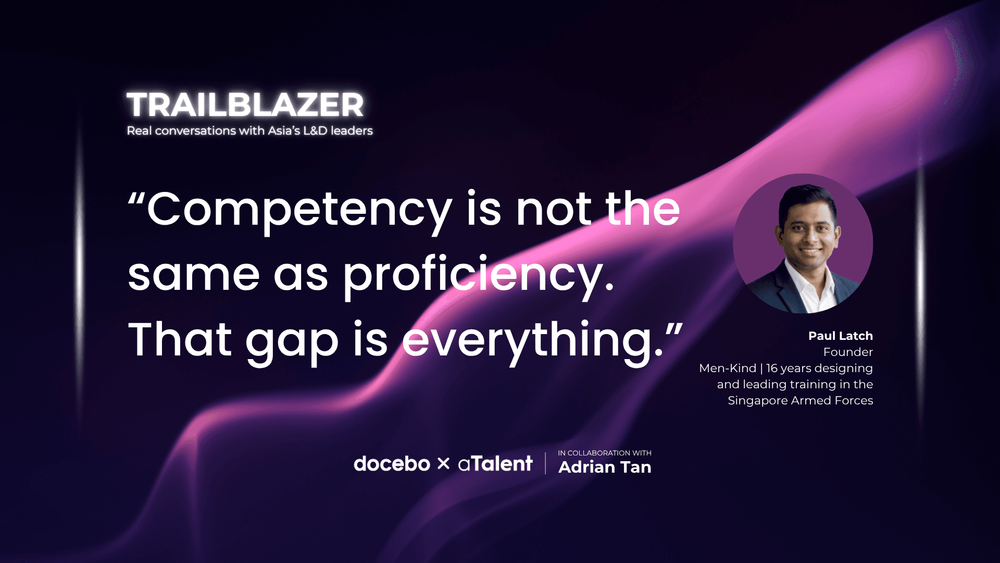
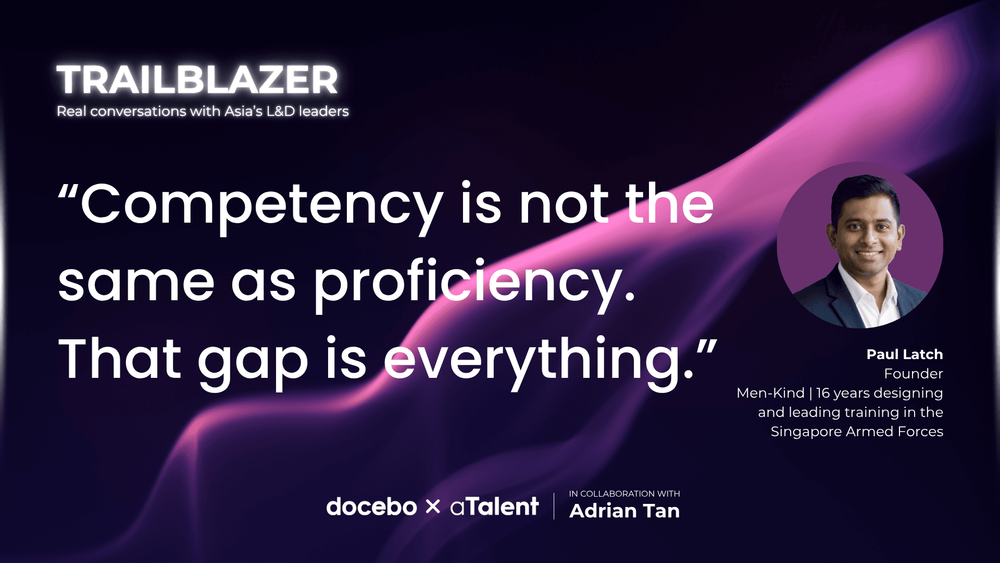
"It’s easy to fake training with activity and output instead of outcome. I sent a thousand emails, which means I’m achieving something. Are you really? Competency is not the same as proficiency. That gap is everything."
The Moment That Made It Real
Paul’s pivotal moment did not come from a classroom or a leadership programme. It came from the COVID-19 crisis, frontline operations, and watching technically competent people freeze when the full weight of the crisis hit.
These were not undertrained people. They knew the doctrine. They had passed every course, often with strong results. And when the pressure arrived in a form the training had not anticipated, the knowledge did not convert to action the way it should have. It is a sobering reminder of why a crisis is not a risk.
“The gap between being competent and being proficient is large,” he says. “Skills are perishable, especially soft skills. If you don’t sharpen the spear, the spear goes blunt.”
That observation sits at the centre of his PhD research at Cranfield, which examines how organisations make decisions in genuine crises and where the gap sits between how leaders think they will perform and how they actually do. It also sits at the centre of everything he builds.

"During the COVID crisis, I watched technically competent people freeze when situations got real. They knew the doctrine. They passed every course. But the knowledge didn’t convert to action. That gap between competency and proficiency is what my research and my training design are built around."
Getting Buy-In Without Betting the Organisation
Bringing senior leaders along on unfamiliar training approaches requires, in Paul’s experience, a specific sequence. You do not sell the idea. You make the cost of the status quo undeniable.
“People move a lot quicker on risk than opportunity,” he says. “Risk will burn you quicker. Opportunity, maybe.”
His approach runs in three layers. First, anchor the conversation in something familiar, readiness, risk, or performance, so the leader is on familiar ground. Second, make the cost of doing nothing explicit and concrete. Third, offer a sandbox: a contained pilot with a clear decision point, so the leader is approving an experiment, not betting the organisation.
“Don’t go Shark Tank,” he says. “Don’t ask for the lead. Offer a controlled step and the evidence to decide on. Give facts, not opinions.”

On Deciding What to Pursue
Paul’s filter for evaluating any new tool or innovation is characteristically direct: does it improve people's performance under real conditions, or does it just improve the learning experience?
If it is the latter, he drops it.
For AI specifically, he sees genuine potential in its ability to help leaders rehearse hard decisions, functioning almost as a digital twin that stress-tests judgment before the real situation arises. He has seen early versions of this emerging in a military training context.
He values skills frameworks, but with a condition: they only work if they become a shared language across the organisation. A framework one person uses in isolation is not a framework. It is a document.
“If something people can build as a shared language and adopt widely, pursue it,” he says. “If it’s just for one person to learn but cannot be implemented, say no.”
“Does this improve people performing under real conditions, or does it just improve the experience of learning? If it’s the latter, drop it.”
What the Profession Will Be Criticised For
Paul’s view of L&D’s coming failure is precise. If the profession continues to focus on delivering knowledge that AI can now provide for free, wrapped in increasingly polished content design and dashboards, it will lose. Not gradually. Decisively.
“AI can write storyboard scenarios,” he says. “Previously, we used people for that. If we are criticised for still teaching knowledge that AI can offer you for free, that will be L&D’s failure.”
The alternative, the version he believes the profession needs to move toward, is also clear: help people think, decide, and lead better. Focus on judgment, not content. Proficiency, not competency. The things that do not transfer from a slide.
“If you focus on that, you’ll be okay,” he says. “If you keep focusing on providing knowledge with a very good wrapper around it, that’s where you lose.”
For Paul Latch, who built an entire training architecture from nothing, now coaches leaders through Men-Kind, and is researching the gap between how leaders think they will perform and how they actually do, that is not a theoretical concern. He has seen both sides of it up close.
Paul Latch is one of Asia’s featured voices in the aTalent × Docebo Trailblazer Campaign — spotlighting the region’s most influential L&D leaders. Learn more at trailblazer.atalent.com After 16 years in the Singapore Armed Forces, where he built and led training for soldiers and commanders, Paul Latch now leads Men-Kind, helping leaders decide and lead under pressure. He writes here in a personal capacity. The views are his own and do not represent the Singapore Armed Forces or the Ministry of Defence.