
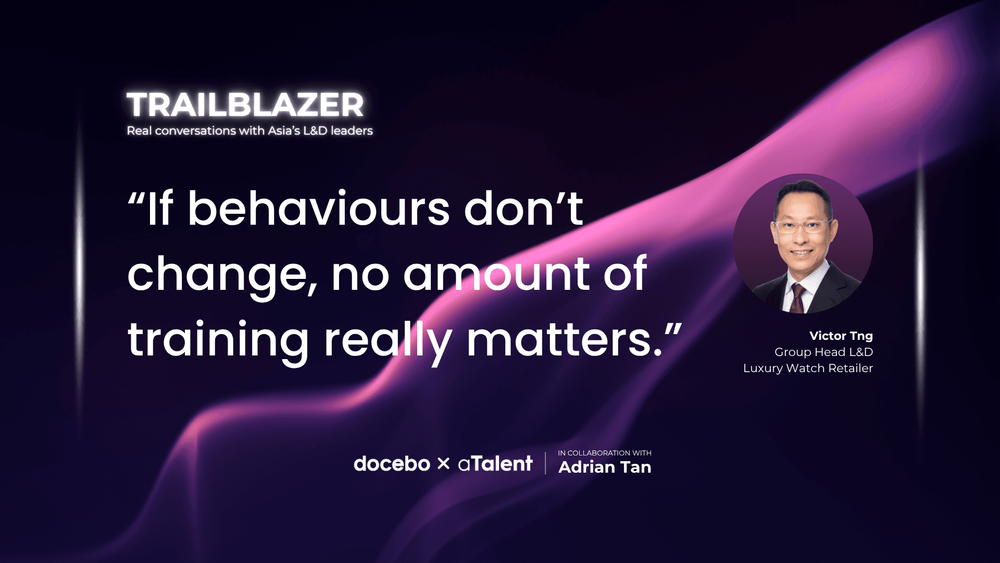
If the Behaviour Doesn't Change, the Training Didn't Work.
Victor Tng has a simple way of explaining what he does to people outside the profession. L&D, in essence, is to help people and organisations turn their dormant potential into consistent performance.
Not through training programmes alone. Not through content delivery or course catalogues. But by shaping how people think, decide, and act at work, the business stops relying on a handful of strong individuals and starts running on a system where excellence can freewheel.
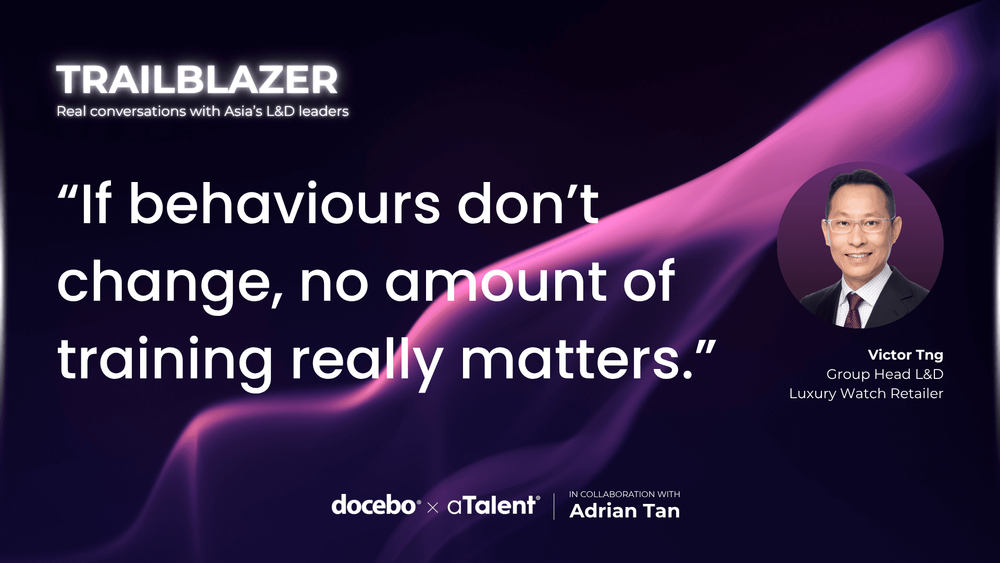
"If behaviours don't change," he says, "no amount of training really matters."
It is a conviction built over more than two decades spanning hospitality, retail, and luxury goods, across Hyatt, Starwood, Dairy Farm, and now a leading luxury watch retailer, where he serves as Group Head Learning & Development. Victor has seen what happens when L&D gets it right, and what happens when it settles for good-looking numbers on a feedback sheet while nothing on the ground actually shifts.
He is not interested in the latter.

From Training Request to Capability Question
The clearest illustration of how Victor works came when a key stakeholder asked him to run a half-day brand storytelling training. The request was straightforward. His response was not.
Instead of delivering what was asked, he pushed back and reframed the conversation: what capabilities are we actually trying to build, and can we sustain them beyond a one-time session?
The answer to that question led to a two-year programme. Not a workshop. A multi-layered learning journey that wove together formal training, self-directed learning on the organisation's e-learning platform, coaching by direct managers, and structured feedback mechanisms applied in the flow of real work.
"The impact was so much greater and the outcome so much more sustainable," he says.
That shift, from being a training machine to engineering genuine role capabilities, also changed how his key stakeholders perceived the L&D function. Once they saw what a properly structured capability journey could produce, the conversation about what L&D is for changed permanently.
"The shift from being a training machine to engineering true role capabilities changed how my key stakeholders viewed L&D entirely. That was the moment everything became different."
The Lesson From the Happy Sheets
Victor's pivotal moment came earlier in his career, when he was still a frontline trainer before moving into management. He watched programme after programme receive exceptional scores on participant feedback forms, only to find that nothing much changed on the ground once people returned to their roles.
The training was engaging. People enjoyed it. And then they went back to work and behaved exactly as they had before.

"A very well-designed training programme can still fail," he says, "especially if the environment doesn't support it."
That experience forced a fundamental rethink. When he eventually moved into a leadership role that allowed him full control of the L&D function, he redirected his focus from content design to ecosystem design. Leadership environment, reinforcement mechanisms, coaching culture, operational realities. The conditions in which learning either takes root or withers.
"L&D is not about just designing great content," he says. "It's much more about creating the conditions for real behavioural change."
Getting Stakeholders On Board
Victor's approach to senior stakeholder resistance is built on a principle he has tested consistently: people resist unclear outcomes, not new ideas.
So he does not walk into those conversations with learning models or conceptual frameworks. He walks in with business language. Productivity levels. Client experience markers. Employee retention rates. Revenue and sales conversion targets. The things his stakeholders wake up thinking about.

He also involves them early, before implementation, rather than after. "Every time I engage them early, when they feel part of shaping the solution, the resistance reduces significantly," he says.
And he starts small. Pilots, quick wins, proof-of-concept initiatives scoped tightly enough to show results without requiring full organisational commitment upfront. Once stakeholders see tangible impact, scaling becomes a far easier conversation.
“The shift from being a training machine to engineering true role capabilities changed how my key stakeholders viewed L&D entirely. That was the moment everything became different.”
Three Questions Before Every Innovation Decision
With AI tools, skills frameworks, and new learning technologies arriving faster than most organisations can evaluate them, Victor applies a consistent filter before pursuing anything new.
First: Does it solve a real business problem? Second: Is it scalable across the organisation? Third: Is it sustainable beyond the initial implementation phase?
Everything else, he argues, is secondary. Including the pressure to be seen as adopting the latest technology.
"It's very easy to get distracted by trends in L&D," he says. "Not every innovation creates meaningful impact. We must never jump into making just tactical decisions."
He has sat with stakeholders who insisted that everything must go AI. And his response? Let’s bring the conversation back to those three questions. If a new tool cannot address them clearly, it stays on the shelf regardless of how impressive the demo was.
What the Profession Needs to Hear
The reckoning Victor sees coming for L&D is direct and uncomfortable: practitioners who continue operating as training machines risk making themselves irrelevant.
The landscape has already shifted. AI coaches exist. Quality learning content is freely accessible to anyone with an internet connection. If the value of the L&D function is simply to organise and deliver training, that value will erode fast.
"L&D will really need to evolve into a function that shifts workforce capability in real time," he says, "using data analytics, integrating what we want to do directly with performance, and influencing business outcomes. If we don't make that shift, L&D risks becoming irrelevant."
For Victor Tng, that shift is not a future concern. L&D needs to be a “practical strategist” to the businesses that we support, strongly grounded to deliver real impact and outcomes. It is the work happening right now, one behaviour change at a time.
Victor Tng is one of Asia's featured voices in the aTalent × Docebo Trailblazer Campaign — spotlighting the region's most influential L&D leaders. Learn more at trailblazer.atalent.com