

employees set clear goals in Deli Group’s reported project.
OKR
Connect ambition to the work people do
Align objectives across teams, make key results measurable and keep progress visible as priorities change.
managers aligned with company objectives across five countries.
actions were linked to goals in the same project.
Customer evidence · Deli Group · published November 2025 · Deli Group · Goal alignment ↗
Reported project adoption and use; these figures do not establish productivity gains.
Keep strategy in the weekly conversation
A goal is useful when people can see its purpose, progress and next action.
Schedule a DemoKeep priorities connected as work moves
Alignment, visibility and ownership across teams
Cross-team priorities
Resolve competing goals before work diverges
When regions or functions pursue different priorities, connect team objectives to a shared direction so managers can discuss dependencies and trade-offs.
Execution visibility
See the blocked result, not just the completed task
Use progress tracking to distinguish work in motion from results achieved. Review a stalled key result while there is still time to change the plan.
Distributed ownership
Keep local ownership within a common direction
Give teams a clear link between their objectives and the enterprise priority, while keeping responsibility for the work close to the people doing it.
How it works
From objective to progress conversation
- 01
Define
Agree the objective
- 02
Measure
Set key results
- 03
Align
Link related goals
- 04
Review
Update progress and actions
Core capabilities
Align the goals. Follow the results.
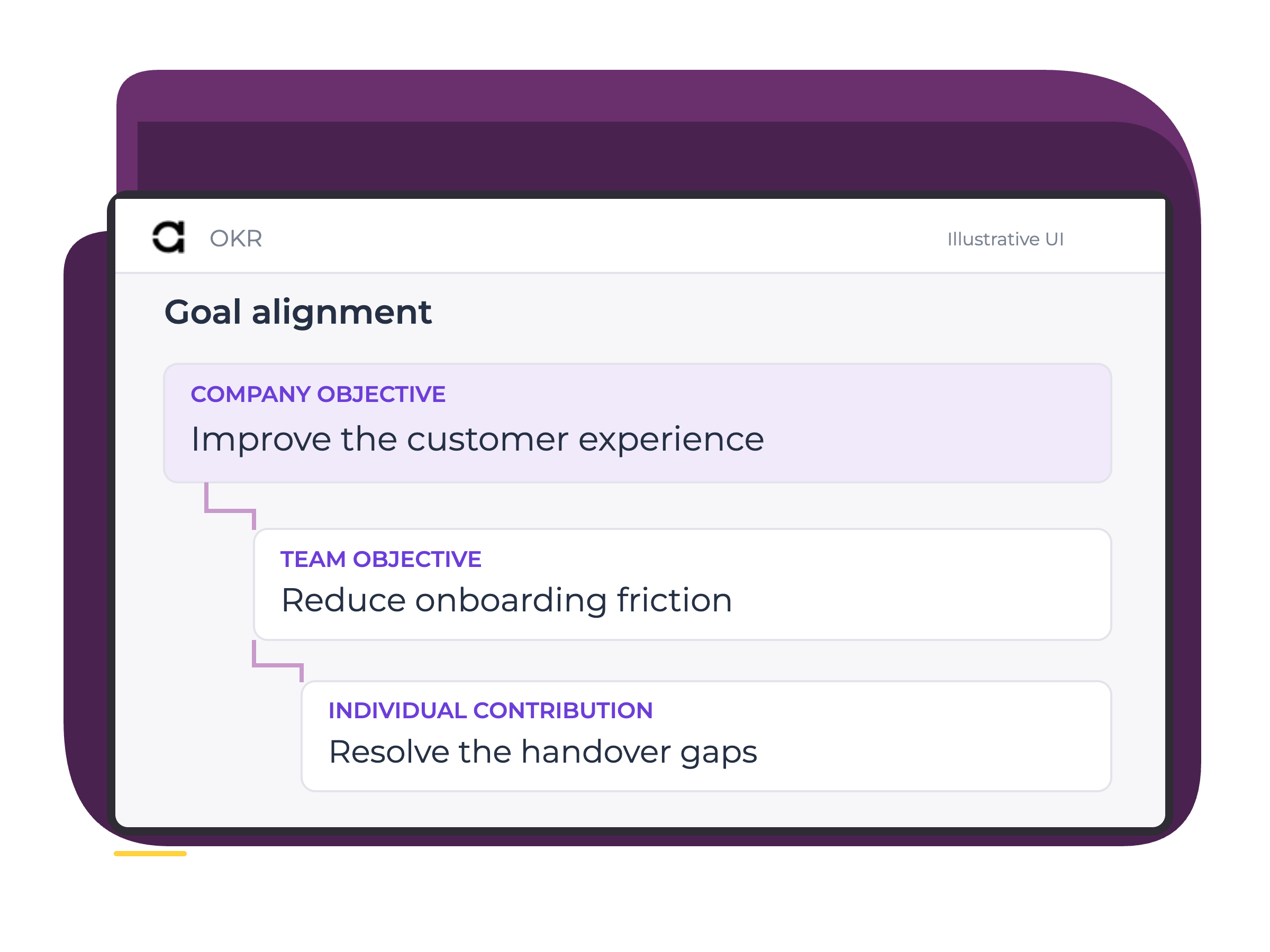
Connect company, team and individual goals
Create, assign and cascade objectives across organizational levels. Make the relationship between local work and company priorities visible.
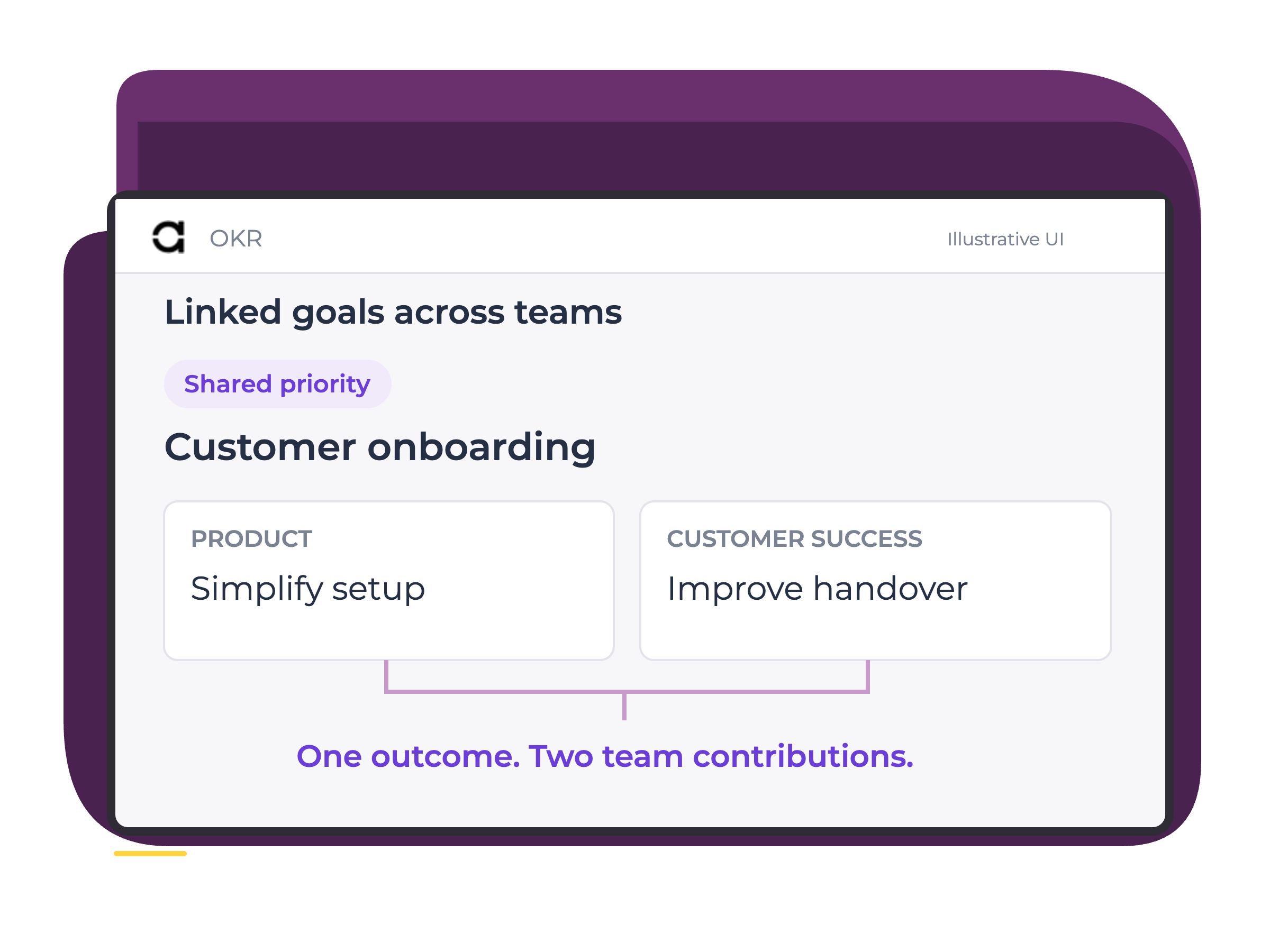
Make alignment a shared conversation
Link related goals across teams so employees and managers can see where work contributes and where coordination is needed.
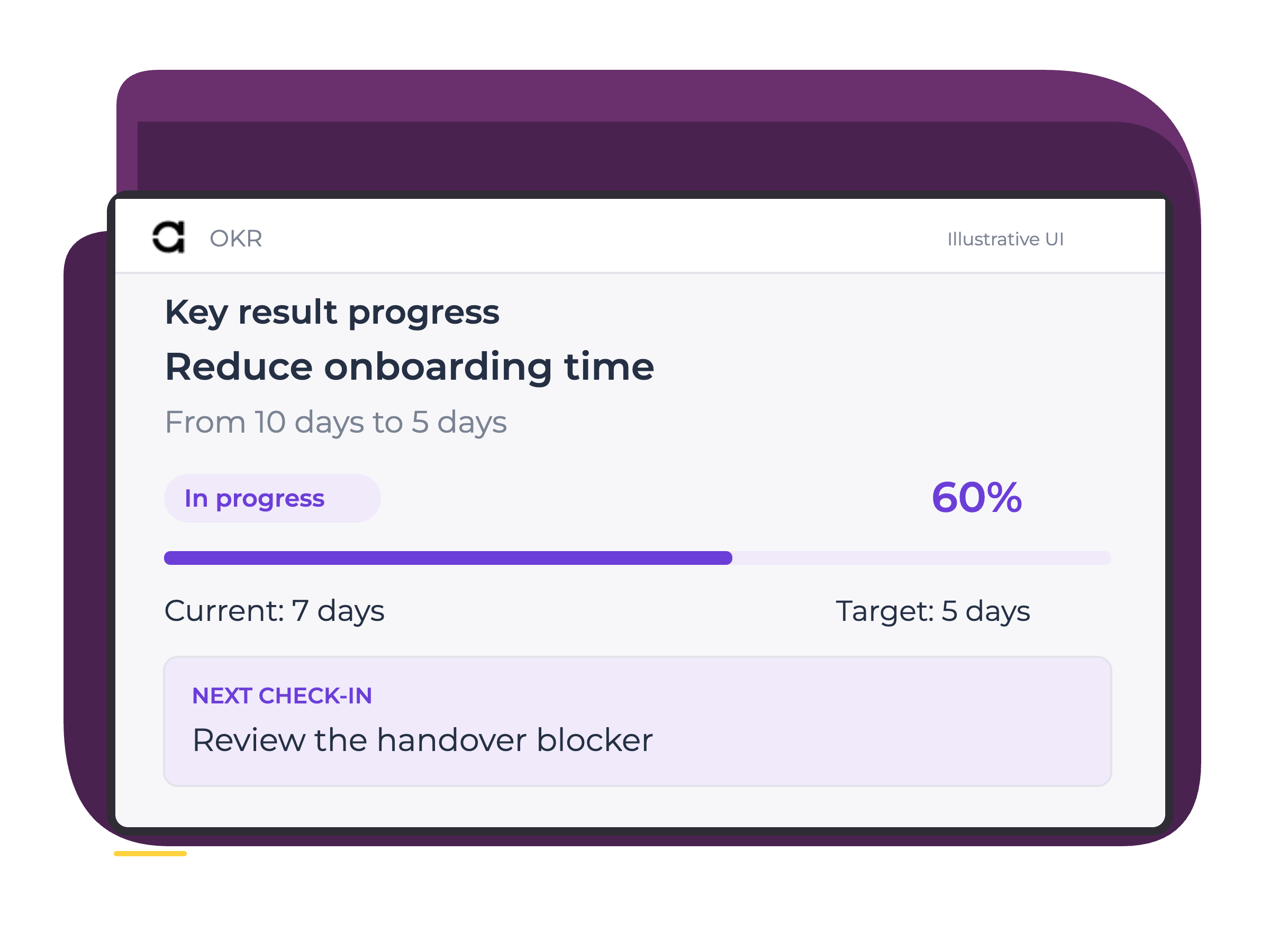
Review progress while the cycle is live
Use progress dashboards and timely feedback to identify roadblocks, discuss a change and decide the next action.
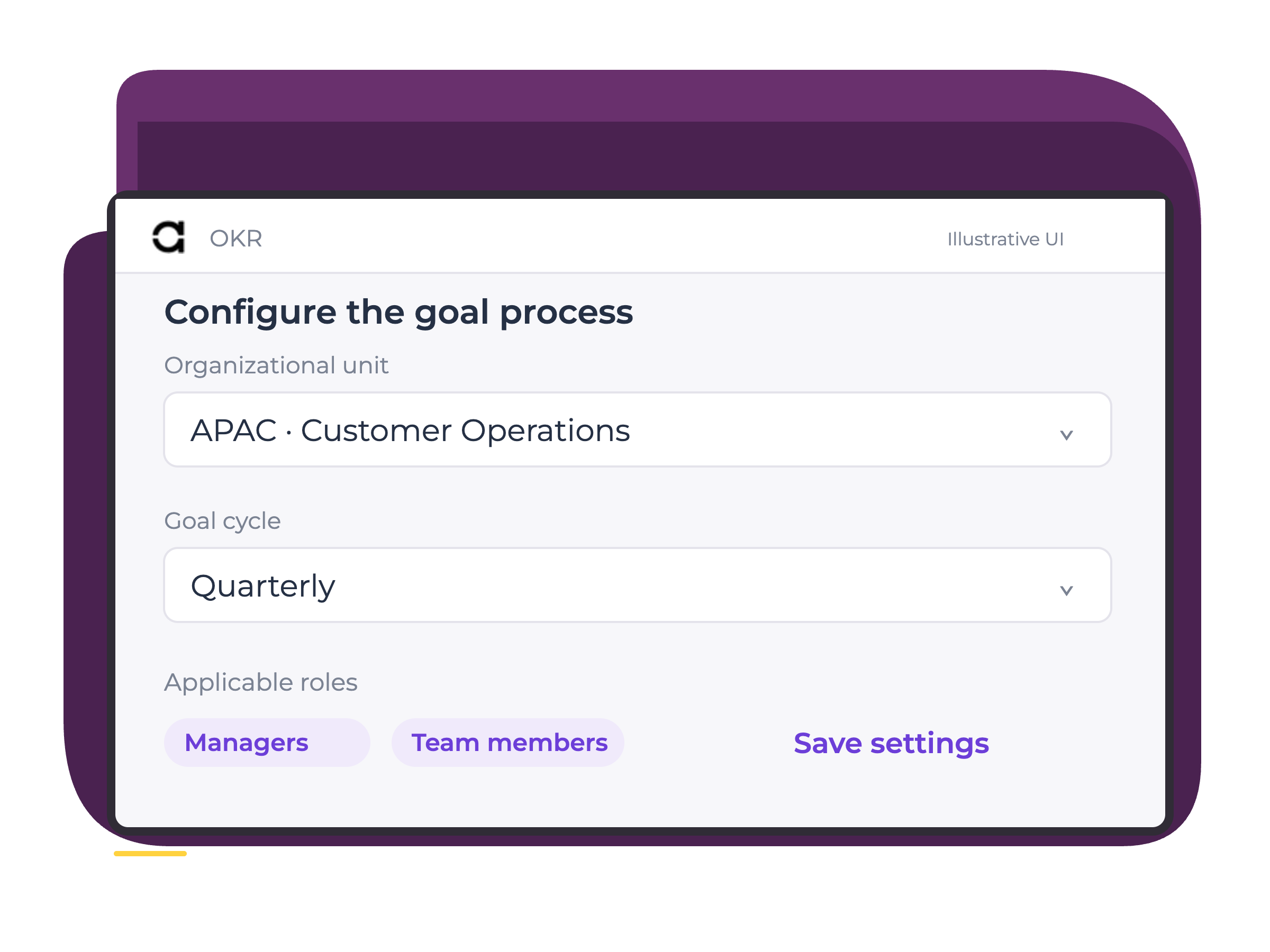
Support complex, distributed organizations
Adapt the goal process to different roles and organizational structures without losing the shared view of priorities.
The goal-quality check
A measurable result is different from a task
Objective
What should change?
State the business or customer outcome that matters.
Key result
How will we know?
Agree a measure, target and time horizon.
Action
What will we do?
Choose the work that could move the result; revisit it when progress stalls.
Research behind the approach
Bersin’s discussion of performance management emphasizes team context, transparent goals and ongoing feedback. Here, that informs a management practice: review outcomes and adjust the work, rather than treat goal entry as the result.
Josh Bersin · Research perspective ↗Connect goals with contribution and growth
Choose the related workflow that supports the decision at hand.
These are related workflows. Module scope and data connections are agreed during implementation
Customer story · Deli Group
A common direction across five countries
Deli’s published story describes fragmented goals across a growing regional business. The project linked OKRs with action plans and cross-border collaboration.
Read the Deli story5 countriesin the published goal-alignment project
The participation figures above describe this project, not a guaranteed result for every organization.
Choose the right goal conversation
Different decisions need different evidence. These workflows can complement one another.
Purpose and evidence across OKR, KPI, Performance review.
Swipe to compare the three workflows.
| Decision | OKR | KPI | Performance review |
|---|---|---|---|
| Main question | What change are we trying to achieve? | How is an ongoing responsibility performing? | How has the person contributed? |
| Typical evidence | Objective, measurable results and progress | An operating measure and its target | Results, behaviors and contextual feedback |
| Review focus | Progress, dependencies and changes in approach | Variance, causes and corrective action | Contribution, expectations and development |
| How they connect | An OKR can include a relevant KPI as a key result | A KPI can show whether the operation stays healthy | Goal evidence informs the review; it is not the whole review |
FAQs
Goal setting, alignment and progress reviews
What does OKR stand for?
Objectives and Key Results. The objective describes a meaningful change; key results describe how progress toward that change will be measured. Actions are the work undertaken to achieve those results.
What is the difference between an OKR and a KPI?
A KPI tracks an ongoing measure of performance. An OKR focuses attention on a particular objective and its measurable results. A useful operating KPI can also become a key result when its improvement supports the objective.
What can aTalent help us do with OKRs?
Create, assign and cascade goals, link individual and team objectives, and review progress through dashboards and feedback. These capabilities support the alignment and tracking process across complex organizations.
Do all goals have to cascade from the top?
No single direction of goal setting fits every team. Company priorities give context, while teams should discuss what they can contribute and where dependencies sit. Agree how your organizational process uses cascading and cross-team links.
How should we write a useful key result?
Describe a measurable outcome with a clear target and time horizon. “Launch a campaign” is an activity; “increase qualified inquiries from the agreed baseline to the target” expresses the result the activity is meant to achieve.
How many objectives should a team have?
Choose a small set that reflects real priorities and the team’s capacity. The right number is a management decision, rather than a target for filling the system.
How often should progress be reviewed?
Use a cadence that fits the work. Short progress conversations help surface blockers between formal reviews. Revisit the objective when business priorities materially change.
Can OKRs support teams in different countries?
The published aTalent page describes configurations for distributed teams and complex structures. Deli’s customer story provides a concrete example of goal alignment across five countries.
Should every OKR determine a bonus?
Avoid assuming that a stretch objective is a compensation formula. Agree the distinction between development, operating commitments and pay decisions before linking goal results to a reward process.
Does tracking progress guarantee better execution?
No. Visibility supports action, but managers and teams still need to resolve dependencies, allocate resources and change the work when needed. A dashboard alone does not deliver the objective.
What do the figures at the top of this page measure?
They are participation and activity figures reported in Deli Group’s published project: employees setting goals, managers aligning with objectives and actions linked to goals. They are not an aTalent-wide productivity benchmark.
How does OKR connect to Performance?
OKR organizes objectives and progress. Performance brings goal evidence into a broader conversation about results, behaviors, feedback and development. Confirm the connected workflows and data scope for your implementation.
Start with a priority that crosses teams
Bring an objective, its success measures and the dependencies you need to make visible.
Schedule a Demo