


Define the capabilities a role or business task actually requires.
Skills
Ready your people for what’s next
Connect role requirements, skill assessments and development priorities around the work ahead

aTalent platformSkills.
Compare skill assessments with role expectations to identify what needs attention.
Choose practice or learning that addresses the gap, then review its application at work.
Our approach · Connect role requirements, skill assessments and development decisions. Informed by Josh Bersin · Skills-based organizations · 2023 ↗
Make the next capability decision clearer
A skills catalog becomes useful when it helps someone decide what to assess, develop or investigate next
Schedule a DemoBuild the skills the work actually needs
Start with a concrete role, team challenge or development decision
Changing role requirements
Define what good looks like for the role
When a role changes, a generic skill list can obscure the actual requirement. Map relevant capabilities to the role so employees and managers can discuss the same expectations.
Targeted development
Prioritize the gap behind the training request
A request for more training does not identify what is missing. Use assessment and gap analysis to clarify the capability that needs attention before selecting learning or practice.
Team capability
Find where the team needs support
A team can have strong individuals and still lack a critical capability. Examine gaps at team level to decide where deeper assessment, shared practice or additional expertise is needed.
How it works
From role requirements to a development priority
- 01
Define
Agree the skills relevant to a role
- 02
Assess
Bring self and manager assessments together
- 03
Compare
Review gaps against role expectations
- 04
Develop
Choose learning and practice around a priority
Core capabilities
Connect the framework to the individual
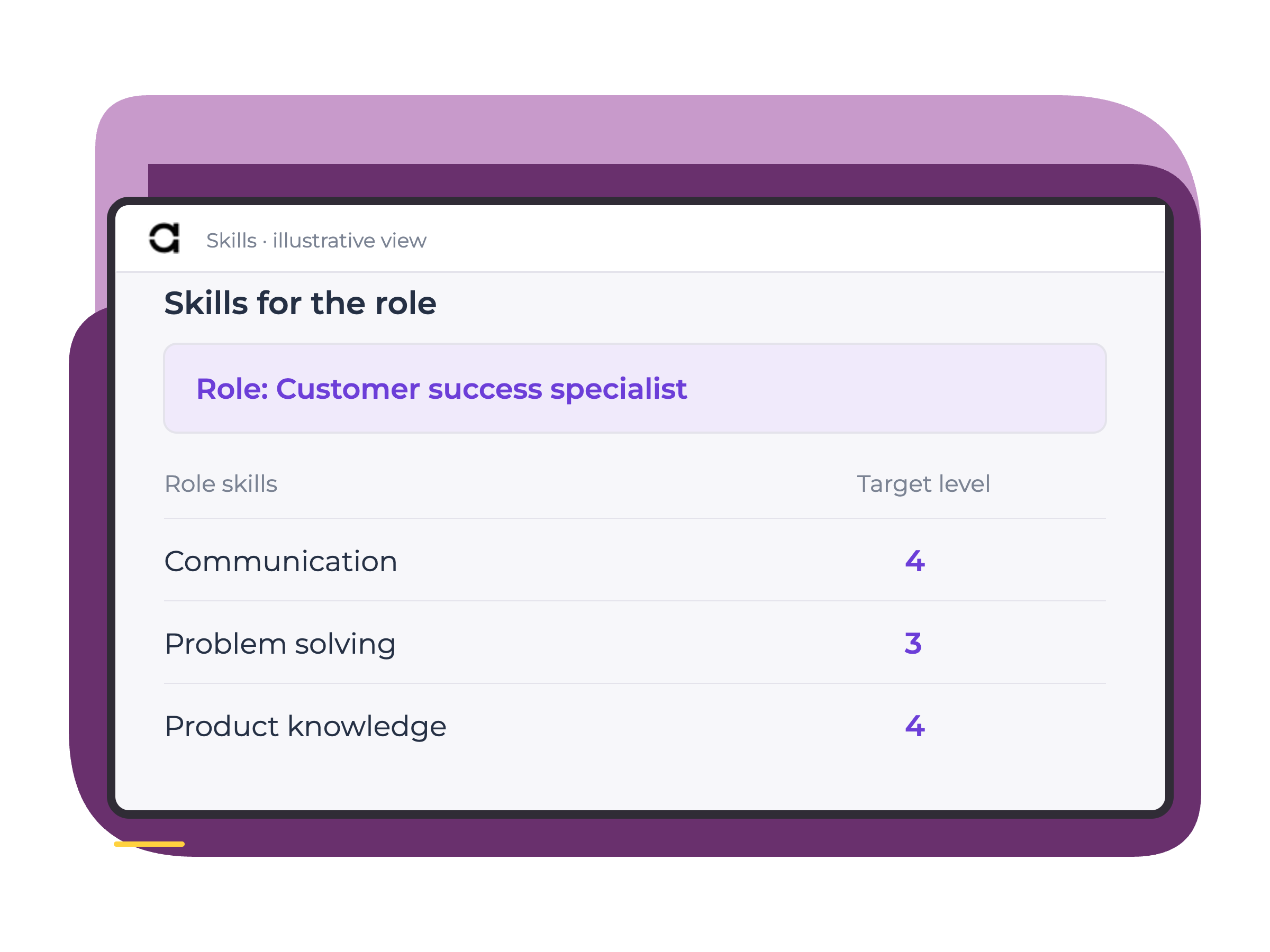
Give roles a shared skills language
Use role mapping and relevant national or industry frameworks to organize the capabilities people need.
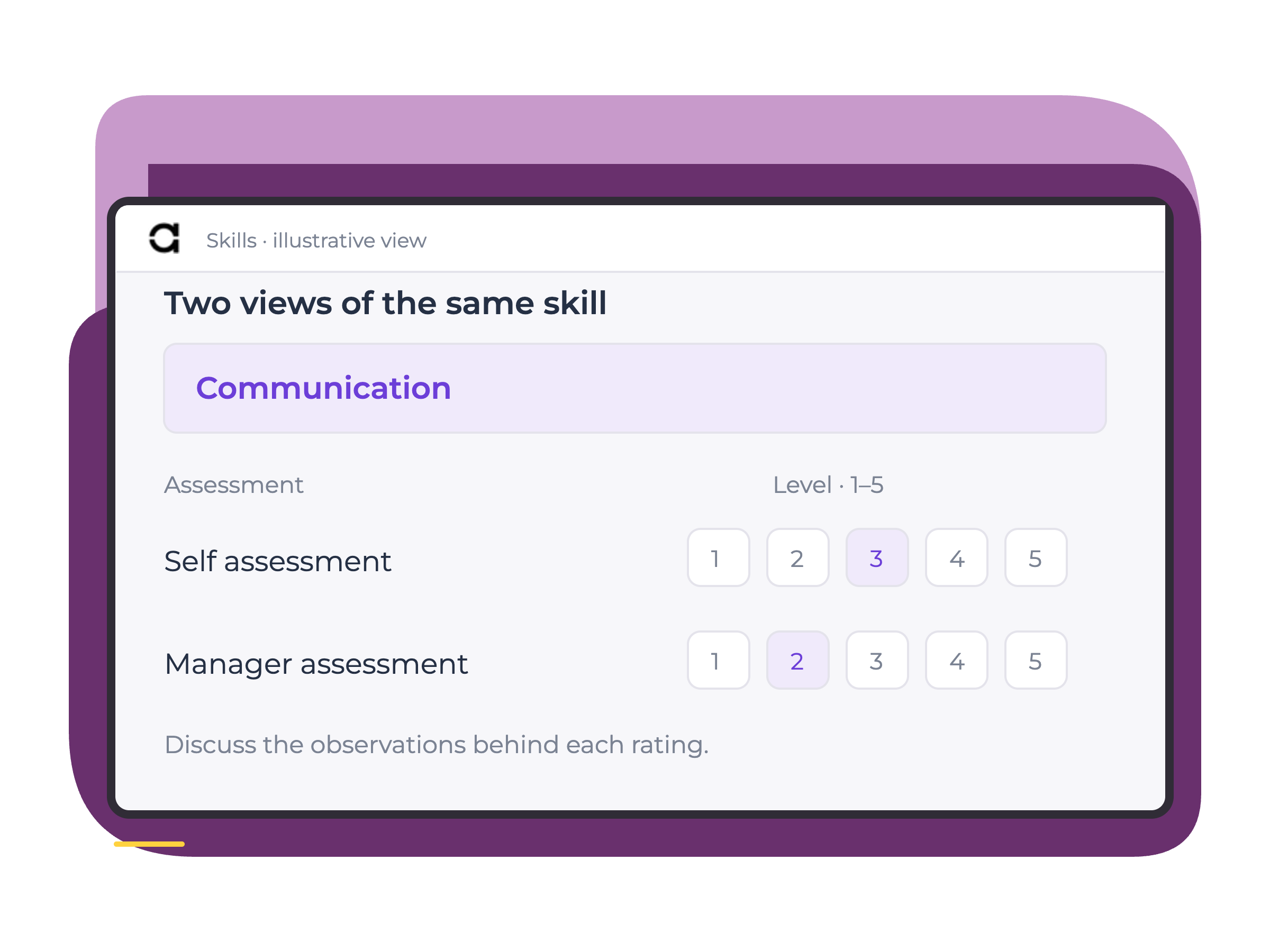
Bring employee and manager views together
Support self and manager skill assessments. Discuss differences in context before agreeing what needs development.
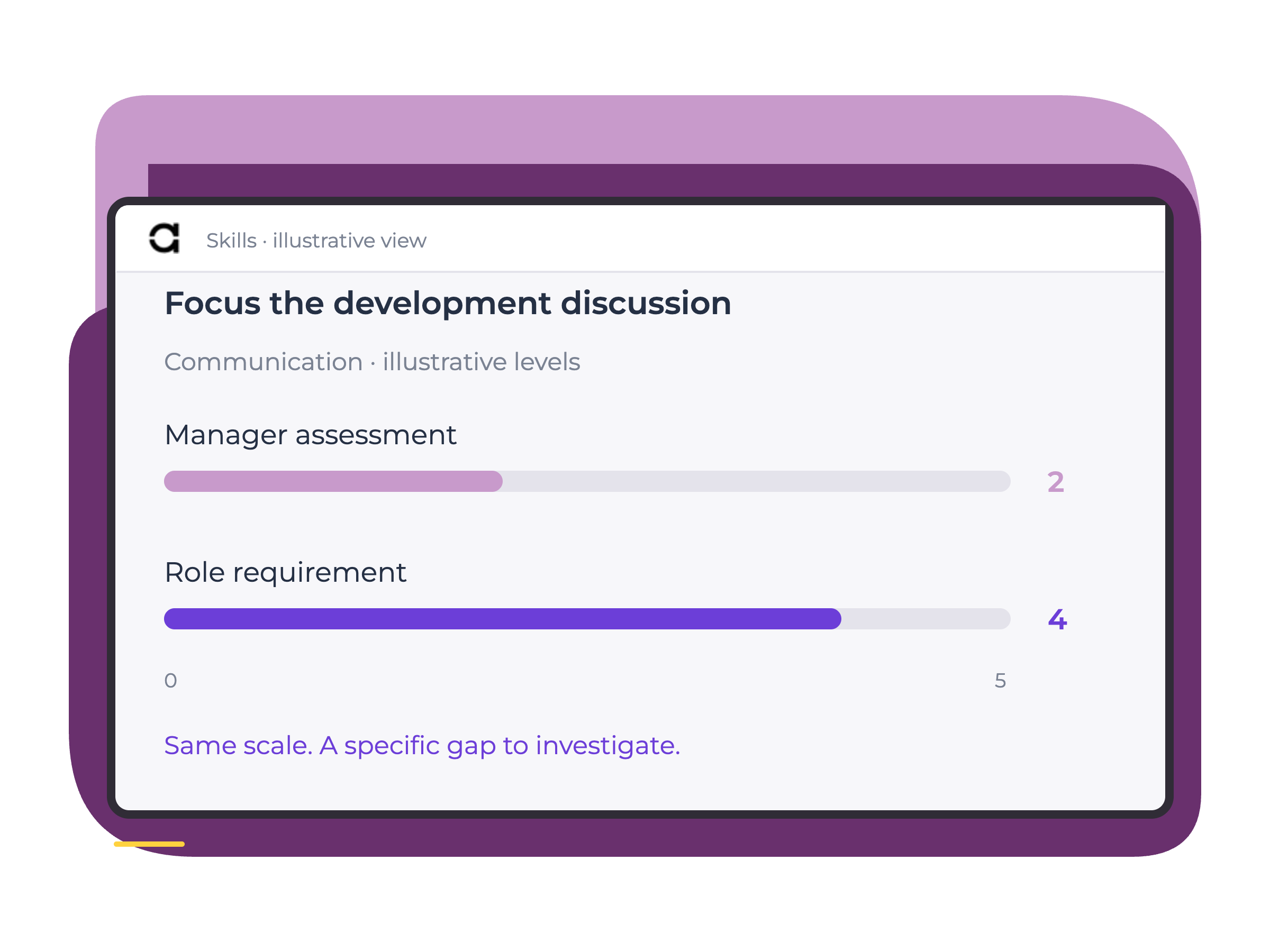
See where capability needs attention
Review individual, team and organizational skill gaps, then focus development on the relevant requirement.
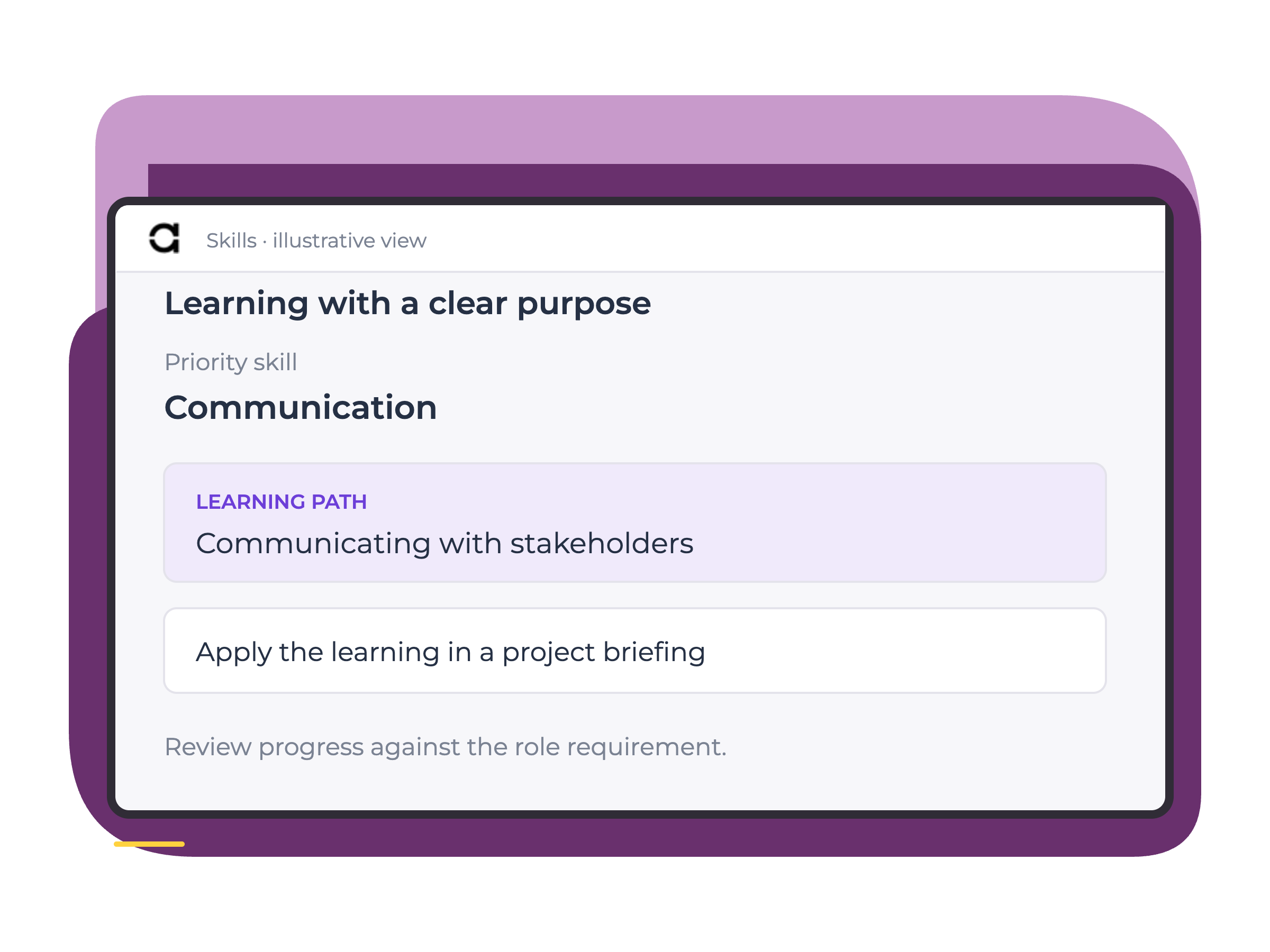
Give learning a specific purpose
Use personalized skill-based learning paths to address development needs identified in the assessment.
A role changes the question
The same skill. A different requirement.
Choose a role to see how its expectations change the development conversation.
Illustrative skill · communication
Explain complex work clearly
Discuss a technical recommendation and how its audience understood the trade-offs.
Development conversation
Practice a stakeholder briefing
Agree who will observe it and what feedback would show progress.
Illustrative skill · communication
Give clear direction through change
Discuss how priorities, responsibilities and trade-offs were communicated to the team.
Development conversation
Lead a change briefing
Seek feedback on clarity, questions and the team’s understanding of next steps.
Illustrative planning example, not a live assessment or product screenshot. Requirements and evidence depend on your role framework.
Why start with the work?
Bersin’s 2023 analysis argues for solving a specific business problem rather than building an exhaustive taxonomy first. Our application of that principle: select a meaningful role, examine its requirements and use the findings in a concrete development decision.
Research & context ↗Use skill context in the next talent decision
A gap should lead to a relevant conversation or development action
These are related workflows. Module scope and data connections are agreed during implementation
Assistance with a review point
Mapping is a starting point for a decision
SkillMap
Role + library
The published Skills page describes competency mapping using industry-aligned libraries.
GapFinder Analytics
A gap to investigate
Gap analysis helps identify where assessment and role requirements need closer attention.
Human judgment
A relevant next step
Review role context and assessment evidence before choosing development. Confirm available AI features, inputs and controls in your demonstration.
Product source & scope
aTalent · Published Skills page ↗Feature descriptions summarize the public product page. They do not establish a particular inference source, validation workflow or connector as included.
Compare how skills become useful
Look beyond the size of the skills library
aTalent strengths to explore Documented vendor strength
Documented strengths, not exclusivity or a ranking.
Published capabilities reviewed 22 November 2026. Products, editions and implementation scope differ.
Swipe to compare all three products.
| Buying question | aTalentSkills | SAP SuccessFactorsTalent Intelligence Hub + career development | WorkdaySkills Cloud |
|---|---|---|---|
| Skills foundation | Role mapping and national or industry frameworks. | Attributes library for skills and competencies. | Skill connectionsAI surfaces connections between skills. |
| Assessment context | Two perspectivesSelf and manager skill assessments. | Attribute proficiency scales and employee growth portfolios. | A skills view across the talent ecosystem; confirm assessment workflow. |
| Role gaps | Individual, team and organizational gap analysis. | Career Worksheet supports current and target role skills. | Tracks critical skills to inform workforce decisions. |
| Development use | Personalized skill-based learning paths. | Role exploration through related career development tools. | Surfaces growth and internal mobility opportunities. |
FAQs
Role requirements, assessment and development decisions
What is skills management?
It connects the capabilities required by the work with what people can demonstrate and what they should develop next. A useful starting point is a defined role or business problem.
Where should we begin?
Choose a role family or team with a specific capability need. Agree the decision you want to improve, then define the minimum relevant skills and assessment scope.
Do we need to finish a company-wide taxonomy first?
No. A focused scope lets you test whether the language, assessments and resulting actions are useful before extending the model. This follows Bersin’s problem-first approach.
Can we use national or industry frameworks?
aTalent Skills supports alignment with national and industry frameworks. Check the coverage and adaptation needed for your roles during scoping.
Who assesses a skill?
Employees and managers can assess skills. Agree the assessors, the meaning of the scale and what information they should consider.
What if self and manager views differ?
Treat the difference as a reason to discuss the work and the assessment criteria. The views may reflect different observations; do not assume their average establishes proficiency.
Is a course completion proof of proficiency?
Completion establishes participation, not necessarily application at work. Decide what demonstration, observation or assessment is appropriate for the skill.
Can we look at team gaps?
Compare skill gaps at individual, team and organizational levels. Confirm the grouping and reporting views needed for your implementation.
Should we assess only technical skills?
No. The relevant mix may include functional, operational, interpersonal or leadership capabilities. Choose skills because they matter to the work.
Does a gap automatically mean training is needed?
No. Investigate whether the issue concerns practice, feedback, tools, role clarity or learning before selecting an intervention.
How does this connect to development?
Connect skill needs to personalized learning paths. Related IDP or career workflows can provide context for objectives and follow-up; confirm the connections in scope.
Can skills data decide who should be promoted?
It is one input. Role requirements, relevant experience, interest and an authorized decision also matter. A skill rating alone does not establish readiness for a role.
How should we handle AI-inferred skills?
Ask which source supports an inference, how it can be reviewed and how it differs from an assessment. Validate the AI capabilities and controls available in your environment.
Which ideas come from Josh Bersin?
Problem-first implementation, linking skills to actual work, including broader capabilities and using human discussion alongside technology. The article informs our approach; it does not certify aTalent functionality.
Bring one capability challenge
Choose a role, the skills it needs and the development decision you want to improve
Schedule a Demo