You Cannot Help the Business Grow Until You Understand What the Business Needs.
Adeline Looi's first choice was HR. She didn't get it.
She'd just finished a young high-potential programme at Dutch Lady, and her cohort was choosing functions. Everyone got their first pick. Except her. Her CEO, who was also her mentor, exercised his right to override her and sent her into the business instead.
She was furious. Twenty-something, bright-eyed, certain she knew better. Her mentor gave her one line she still repeats today.
“You cannot help the business grow until you understand what the business is.”
So she went. Sales. Trade. Key account management. Brand. A chemical engineer by training, she'd already spent two years as a technical product engineer before HR ever entered the picture. She added close to a decade more in brand management, change management, and consulting before she set foot back in HR and L&D.
Twenty-plus years later, she's Group Head, Director of Leadership & Talent Development at Link Asset Management in Hong Kong. Before that, she headed up integrated Talent for the Asia Pacific region at Estée Lauder. Before that, with over nine years at Nestlé (in a market role in MYSG, then across Zone Asia Oceania Africa, to finally be promoted into Global roles in Switzerland), where she built out global leadership development and assessment functions across six regions and roughly 273,000 employees. Her dual track of corporate and consulting backgrounds help her focus her team always on what really drives impact. Forbes profiled her for personalising leadership development at scale for 30,000 people leaders. HR Executive Magazine named her a Rising Star in 2022.
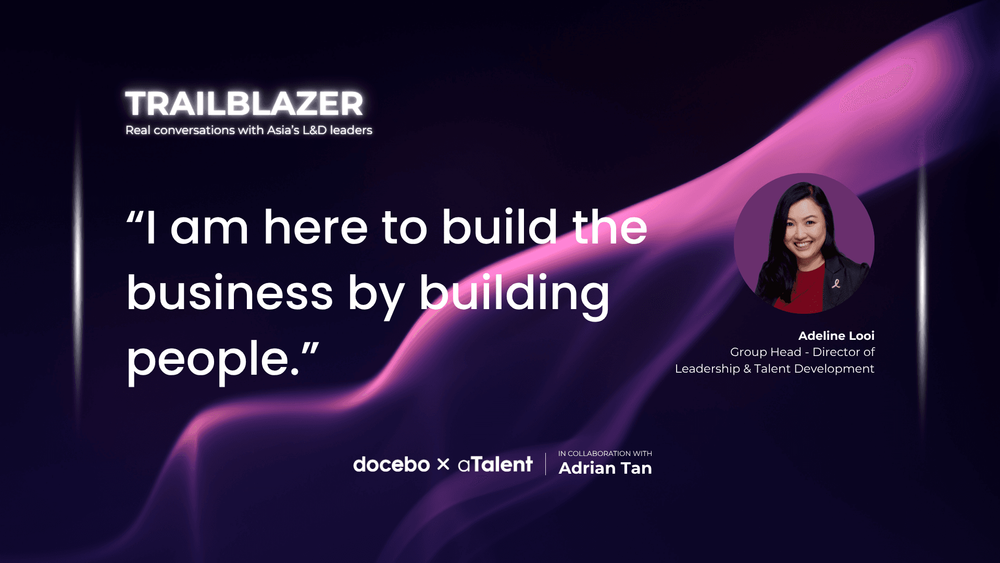
Ask her to explain the job to someone outside HR, and she skips the jargon. “I am here to build the business by building people,” she says. The interventions don't have to be training. They just have to work
Building for an Audience of One
Years into her HR career, the industry was rolling e-learning out at scale: check the box, reach as many people as possible, call it development. Adeline and her team looked at what the business actually needed and saw something else. Less one-size-fits-all leadership content. More personalisation, built around the person in front of them.
“Instead of rolling out something designed for the mass, we talked about customising and personalising for the audience of one.”
It was an unusual call at the time. Nobody was building for an audience of one instead of pushing sixteen hours of e-learning onto everyone. “Now people go, yeah, but that's wisdom,” she says. “Back then, it was pretty unconventional.”

Three Things She'll Argue Against in Any Room
The first is that people can't change: a leopard can't change its spots, so you either have the mindset or you don't. She thinks that's wrong. Not everyone is coachable, she'll grant that much, but writing someone off as fixed is a different claim entirely, and she doesn't buy it.
The second is that good L&D people have to come from a training background: articulate, comfortable on a stage. She'd argue the job was never about talking to people. It's about matching people and business needs to the right intervention.
The third is the one she pushes back on hardest: that L&D is a nice-to-have, something you fund once the business is doing well. She sees it in reverse. The people who build capability inside a business aren't a cost centre. They're the engine room.
Eating the Beta Pill Before Asking Anyone Else To
Her biggest test of that belief came at Nestlé, where she was asked to stand up a global talent assessment function from scratch, across a company of 270,000 people.
The resistance wasn't about competence. Senior leaders in that environment built succession decisions on relationships: I know this person, I've seen them deliver. Adeline wanted to bring data and insight alongside that instinct, not instead of it. To her stakeholders, weighing numbers against gut feel felt like a threat.
The CEO backed the direction in principle. He also wasn't sure her approach was the right one. So she and her team didn't roll it out top-down. They piloted it small, and they piloted it on themselves first.
“As HR, we applied it to ourselves first. We ate the beta pill, we learned from it, we iterated, and we shipped it up better before rolling it out broader.”
Within eighteen months, the whole organisation had adopted the new approach to senior talent assessment as well as people leader personalised development. It scaled to nearly every region that Nestlé operated in worldwide, and the talent pool widened with it: no longer concentrated in Europe, but pulling from Asia, the Middle East, and North America too, where much of the business actually sat.
The Filter for What to Chase and What to Ignore
Adeline is, by her own account, curious. New tools, new frameworks, new hybrid formats: she's drawn to most of it. Which is exactly why she built a filter for what to leave alone.
“If it's not directly related to solving a business problem, I turn my back,” she says. “It can sound sexy, it can sound cool. But is it going to drive real impact, or is it just going to make me, my team, or my boss look good?”
The reverse test matters just as much. If something new carries real risk but solves a genuine business problem, she'll go for it. The clearest example is AI coaching, from before generative AI was a mainstream conversation. As Nestlé's Global Head of Integrated Leadership Development, she was accountable for coaching networks across six regions, staffed by ICF-certified coaches working as internal leads. It worked until COVID grounded her coaches and demand for coaching climbed at the same time teams were forming and reforming faster than her network could keep pace with.
So she went looking, found a startup building AI-assisted coaching (human-led, with AI carrying the relationship forward over time), and piloted it across Asia Pacific, the UK, and North America. Being an early customer meant she could push for the features her business actually needed. That startup isn't a startup anymore.
“Technology helps us become more human,” she says. “It helps us scale. So why not use both?”
Walking the Talk When the Team Is Watching
Ask Adeline what today's L&D will get criticised for in three to five years and she doesn't hesitate: not moving fast enough.
Her father warned her about this before she ever took the job. Don't go into HR, he told her. L&D gets the worst of it, always blamed for not doing enough, always judged with the benefit of hindsight. He's since come around. She hasn't stopped hearing the warning in the back of her mind.
Her answer isn't to slow down and play it safe. It's to make sure her own team is living the change they're asking the rest of the business to make. Six months ago, one of her people made e-learning videos. Today, the same person builds AI-generated learning videos, and the team runs lunch-and-learns to teach each other whatever's new that week.
“We really need to walk the talk,” she says. “Taking risks is okay. Making mistakes is okay, as long as we learn from them. We need to reframe what success & failure really mean.”
It's the same instinct that sent her into sales and brand two decades before anyone called it a personal development strategy. Her first question to any team that walks in with a training request hasn't changed since her mentor first told her to go and figure out what the business actually did.
“What business problem are you trying to fix?” she asks. Then she works backwards.
Adeline Looi is one of Asia’s featured voices in the aTalent × Docebo Trailblazer Campaign — spotlighting the region’s most influential L&D leaders. Learn more at trailblazer.atalent.com