If Training Is Your Only Answer, You're Probably Asking the Wrong Question.
William Loh has a rule when someone tells him a problem needs training: he doesn't take their word for it.
Not because he's contrarian — though he'll admit he's comfortable taking risks — but because two decades across organisational development, quality management, and L&D have taught him that training is rarely the whole answer, and often not the right one. The reflex to prescribe a course when something goes wrong is, in his view, one of the most persistent and costly habits in the profession.
As Assistant Director of Learning & Organisational Development at Kwong Wai Shiu Hospital — Singapore's AIC’s largest Learning Institute in the Community Care sector, and a three-time appointed Industry Lead Training Provider, William has built something considerably more sophisticated than a training function. He calls himself a capability and people development partner. What he really is, is a systems thinker who happens to work in L&D.
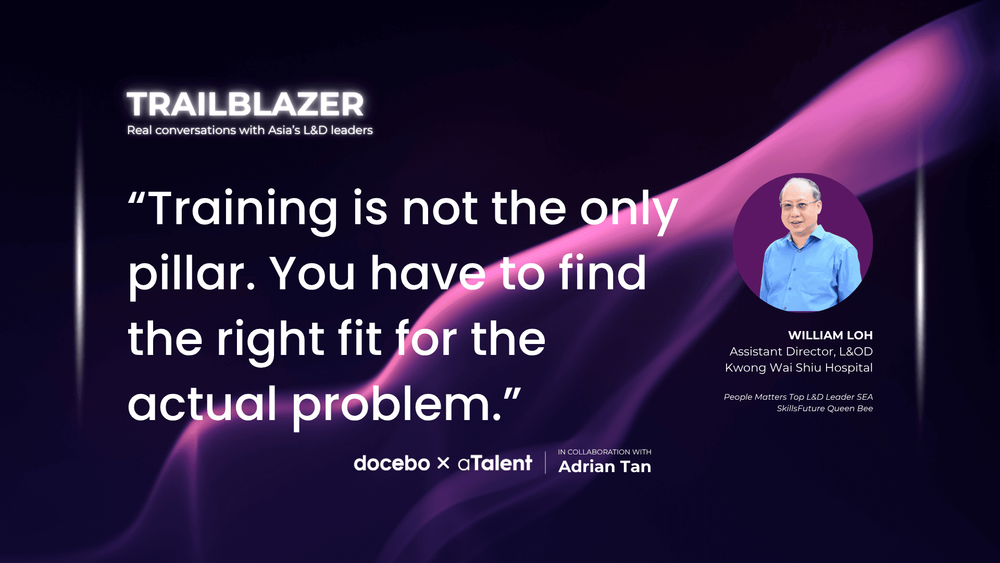
"Training is not the only pillar," he says. "There are many ways to intervene — human behaviour changes, mindset changes, process changes, role redesign. You have to look at whether it's a skill problem, a system problem, or a systemic problem. And then find the right fit."
On Doing Things Differently
William came to L&D via an unusual route — quality management and organisational development at the National Library Board, where he led process transformation and helped the organisation achieve the Singapore Quality Award, the People Excellence Award, and the Singapore Service Excellence Award. That background gave him a lens most L&D practitioners simply don't have.
"My peers who came up through L&D from the ground — many of them still come across as rather conventional," he observes. "Still anchored on the traditional training management approach, annual learning needs analysis exercise, programme delivery. Those things are still useful, but times have evolved."
His own approach, shaped by that OD and quality background, is to start with the actual problem. In the healthcare setting — a workforce that runs on shifts, skews international, and has limited windows for formal learning — the traditional approach simply doesn't hold.
"People here don't always have time to learn in the conventional way," he says. "So we expanded to just-in-time learning, self-directed learning, OJT, competency-based learning and preceptorships. Things that in the traditional view weren't even remotely linked to L&D."
"There are many ways to intervene — behaviour change, mindset change, process redesign. Training is not the only pillar. You have to find the right fit for the actual problem."
The Risk-Taker's Playbook
William describes himself, without hesitation, as someone who likes to take risks. But listen to how he actually takes them, and a more precise picture emerges: he's a calculated risk-taker who has developed a clear framework for testing ideas without exposing the organisation to unnecessary downside.
His method: start small, confine the pilot, and share the risk wherever possible. When he wants to try something that requires investment, he looks for partners — external organisations, industry collaborators, institutions — so the cost, risk and learning are distributed. And he moves quickly to show results, knowing that outcomes are the most persuasive argument with any stakeholder.
"Do first, talk about it later," he says, with characteristic directness. "If you want to pick this, you need to be prepared for the consequences. Make sure the risk is confined. Pilot it. And show the result confidently."
He's also clear-eyed about the limits of approval-seeking. If a stakeholder is hesitant but the idea is sound, he won't be stopped — he'll proceed, show the results, and let the outcomes make the case. "Sometimes they may not have been initially convinced," he says, "but if the clients like and benefit from it, they will support it."

Speaking C-Suite
One of the most practical skills William has developed over his career is the ability to translate L&D data into something senior leaders actually care about. Raw numbers — training hours logged, completions, programme counts — don't move anyone, he argues. What moves people is consequence.
"Don't show them how many training hours you rolled out. Show them the cost of not having the skill. The downtime. The retention risk. The business impact of the gap."
The framing he returns to: what is the risk to the organisation if this capability isn't developed? What is the opportunity cost to hire externally versus build internally? How does skills development connect to staff satisfaction, workforce retention, and service delivery? These are the levers that make L&D legible to a CEO or a board.
"Less numbers, more messaging," he says. "Outcome-based language rather than programme-based language. That's the way to go."

On Choosing What to Pursue
William's organisation operates in the charitable sector, which means resources are finite and every decision carries weight. That constraint has sharpened his instincts around innovation considerably.
His filter for any new tool or approach is threefold: is it practical, is it sustainable, and is it suited to where the organisation actually is in its maturity? High-end AI solutions might be impressive on paper, but if the foundation isn't there to use them effectively, they become expensive noise.
"Don't try high-end AI if your baseline maturity isn't there," he says. "If something a little better than what you currently do is good enough to make a difference, that's good enough. Learn and mature as you go."
The test he always returns to: is there a real business problem this solves? If yes, a good tool will find its fit naturally. If not, even the most sophisticated solution won't stick.
"If you go in with a tool and can't find the problem it solves, you'll very soon find yourself with an expensive shelf decoration. Start with the problem. The right tool will follow."
What the Profession Gets Wrong
Under William's leadership, Kwong Wai Shiu Hospital has become the first SkillsFuture Queen Bee in the Community Care sector, spearheading digital training and mentorship across the industry. He has won the People Matters & CoachHub Top L&D Leader Award for Southeast Asia, the CX Asia Excellence Award, AI Trailblazers Transformation Award and the IAL InnovPlus Challenge. He has spoken at global conferences and led Gen AI-driven learning projects focused on clinical assessment training and decision-making.
None of that, he'd argue, came from playing it safe or staying within the conventional boundaries of what L&D is supposed to do.
The profession's challenge, as he sees it, is exactly that — the tendency to stay within those boundaries, to default to the familiar, to reach for training when the situation calls for something else entirely. In a rapidly shifting environment, where workforce needs evolve faster than programme calendars can follow, that instinct is increasingly a liability.
"Doing something is better than not doing at all," he says. "Have conviction. And if something goes wrong, just say you tried your best in good faith and take responsibility for addressing any unintended outcomes. That should be enough."
For William Loh, it always has been.
William Loh is one of Asia’s featured voices in the aTalent × Docebo Trailblazer Campaign — spotlighting the region’s most influential L&D leaders. Learn more at trailblazer.atalent.com