The Problem With Sending Someone for Training? You Might Be Solving the Wrong Problem.
Twenty years in L&D will teach you a lot of things. One of the most important, CY Ng will tell you, is when not to reach for training as the answer.
As Assistant General Manager of Learning & Talent Development in one of Singapore's major telcos, and multiple award wins under his watch, including Singapore HR Awards in 2025, CY has spent two decades building a practice rooted in something deceptively simple: curiosity. Curiosity about what people actually need. About the reality they live in. About what's really going on beneath the surface of a performance issue before anyone decides what to do about it.
His framework for L&D, distilled to its essentials, rests on three pillars: strengthen the core, grow people, and build capabilities. Everything else flows from there.
"It's always about people's motivation," he says. "Are they curious about what's around them? Are they exploring new ways of doing things? Those questions actually link back to how I approach every L&D conversation — whether at the individual or group level."
On Taking the Road Less Travelled
CY's career has taken him through telecommunications, higher education, logistics, healthcare, and training — and across every sector, he's noticed the same pattern. When organisations face workplace transformation, they reach for external consultants who arrive with frameworks, run their programmes, and leave. What they often can't account for is culture — the invisible weight that determines whether change actually takes hold.
That's where CY sees his role most clearly.
"A lot of times it's stakeholders like us who pick up the pieces," he says. "Consultants have limited time with the organisation. The cultural factors — the resistance, the unspoken dynamics — those are the things we have to work through. It's never a cookie-cutter approach."
His method is to start by understanding what's really at stake: where is the resistance coming from, and how do you move the needle gradually rather than forcing a solution that won't stick?
"It's never a cookie-cutter approach. You have to understand the organisation's culture first — and then figure out how to slowly move the needle towards the solution."
The Belief He Keeps Pushing Back On
Ask CY what widely held belief he most disagrees with, and he doesn't hesitate. It's the reflex — still alive and well in organisations everywhere — that when someone isn't performing, the answer is to send them for training.
The problem, he argues, is that this skips the most important step: the conversation with the employee themselves. Performance issues are rarely just knowledge gaps. More often, there's a motivation issue underneath, or a communication breakdown between the employee and their manager that no amount of training will fix.
"Training might unlock certain awareness in the individual," he says. "But when the problem isn't just internal to that person — when it's also about the relationship between them and their leaders — they may still not see eye to eye on the same issue. And the problem will persist."
His approach is to build a bridge first. Get both sides into a conversation. Understand the context. Only then decide whether training is actually the right intervention — because the last thing anyone needs is an employee sitting in a programme they don't believe in.
"Half the battle is already lost," he says, "if the person doesn't want to be there."
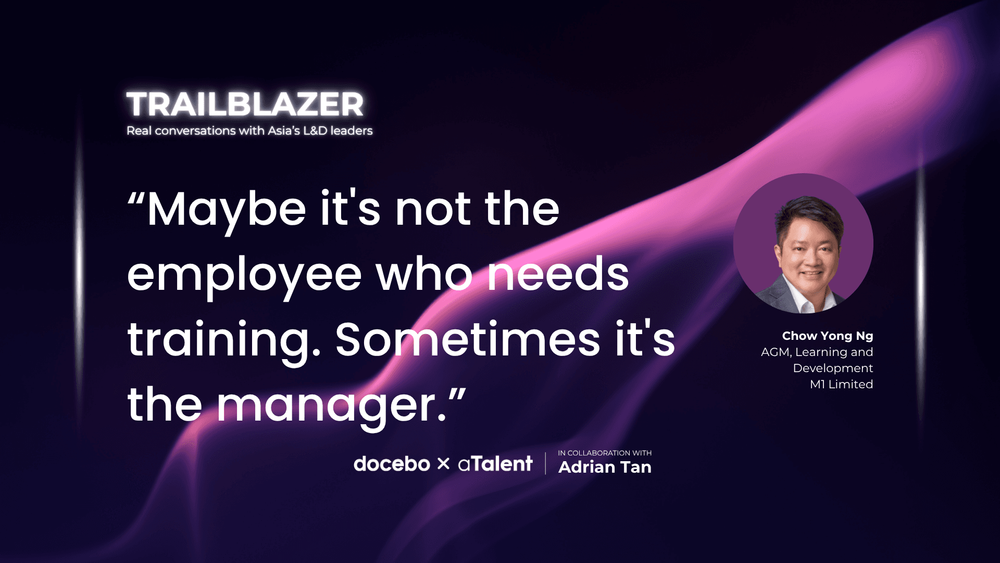
"Maybe it's not the employee who needs training. Sometimes it's the manager. That discovery only happens if you're willing to have the conversation first."
The Moment That Shaped Everything
CY's most personal answer comes when he's asked about the pivotal moment that shaped how he works today. He doesn't point to a programme that failed, or a leadership lesson, or a career inflection point. He points to fatherhood.
His eldest son, now 14, was diagnosed with special needs — an experience that opened CY's eyes to the world of neurodivergency and fundamentally changed the lens through which he sees people.
"That opened up my world in terms of looking at people in a more empathetic way," he says. "Being more vested in building people relationships. Being curious about the reality that others live in."
It's a quality that shows up in everything he does — from the way he approaches resistant stakeholders to the way he designs learning that actually meets people where they are. In a profession that can easily become transactional, CY's practice is grounded in something more durable: a genuine interest in the human on the other side of the table.
On Getting C-Suite Buy-In
When it comes to bringing senior stakeholders along on unfamiliar ideas, CY takes a notably human approach in a field that often defaults to ROI decks and data presentations. His starting point isn't the business case — it's psychological safety.
C-suite leaders, he observes, bring decades of experience and deeply held perspectives to every conversation. Those perspectives shape their decisions — and when challenged, can make a boardroom feel combustive. The key, in his experience, is to find the right setting.
"All it sometimes takes is a one-to-one conversation," he says. "People bring a different persona in a group setting compared to an individual one. You need to create the conditions where they feel safe enough to say what they actually mean."
Only once that trust is established does the conversation about new ideas become genuinely possible.
On Filtering What's Worth Pursuing
With AI tools, skills frameworks, and learning innovation all competing for attention, CY's filter is straightforward: what's the use case, and does it tie back to a real business requirement?
He's observed that institutions and training providers have no shortage of solutions. What they often lack is context — the organisational specificity that makes a solution actually relevant. Bridging that gap, he argues, is precisely the job of the L&D practitioner.
"We need to build that bridge between external providers and the internal stakeholders of the organisation," he says. "To communicate what each party really needs from the other. That's our role."
The Reckoning He Sees Coming
CY's outlook on the future of L&D is shaped by a concern he sees building in plain sight: in a world where information is everywhere, and individuals can upskill themselves independently, the gap between personal learning journeys and organisational direction is widening — and most L&D functions haven't figured out how to bridge it.

New graduates are entering a workforce marked by uncertainty, with job security harder to predict and career trajectories less linear than ever. The old compact — attend training, earn a promotion — no longer holds. What matters now, he argues, is skills portfolio: the demonstrable ability to apply capabilities across shifting roles and contexts, including as internal contributors in ways that organisations haven't yet learned to recognise or reward.
"Gone are the days of hoping that company training leads to a promotion. What matters now is your skills portfolio — and how you create your own marketplace through it."
The L&D profession's failure, in his view, will be in not helping individuals navigate this fast enough — not becoming true partners in shaping self-directed learning journeys that benefit both the person and the organisation they work within.
For CY Ng, the answer has always started with a question. Not "what training does this person need?" — but "what is actually going on here, and what does this person really need to grow?" After twenty years, that instinct hasn't changed. If anything, it's sharper
Chow Yong (CY) Ng is one of Asia’s featured voices in the aTalent × Docebo Trailblazer Campaign — spotlighting the region’s most influential L&D leaders. Learn more at trailblazer.atalent.com