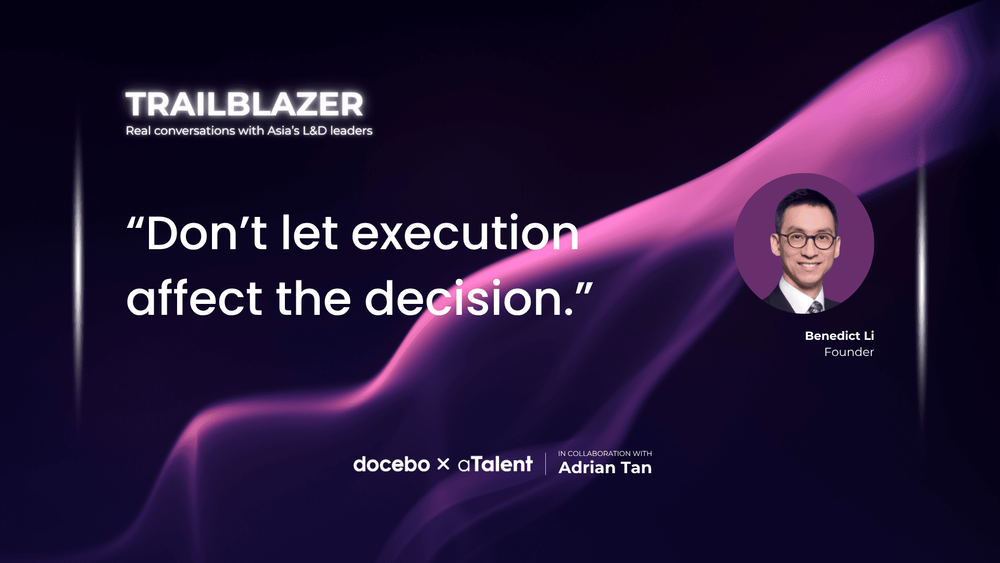
Don't Let Execution Affect the Decision.
Ten years ago, Benedict Li asked himself a blunt question: was he better than the average L&D professional? The answer was yes. The problem was that nobody else could see it.
So he went looking for one thing that could make his value obvious. It had to meet three tests: he had to be motivated to work on it, strong at it already, and it had to stay relevant well into the future. The answer took a while to find. It was presentation.
Most L&D people, he realised, only train for one kind of room: the ballroom, large audiences, a stage, a slide deck built for reach. Almost nobody trains for the other kind, the boardroom, where the audience is small, senior, and unimpressed by polish alone. Benedict went after both. What he took from the exercise mattered more than the skill itself: winning in L&D requires leader buy-in, a business perspective, and the confidence to recommend a clear path instead of laying out options and hoping someone picks one.
That distinction now runs his business. After nine years as Group Head of Learning & Development at DFI Retail Group, formulating group L&D strategy for over 40,000 employees across brands like Mannings, 7-Eleven, IKEA, and Wellcome, Benedict founded Lemon Learning in Hong Kong: executive presentation coaching and corporate training built specifically for managers and senior leaders.
Ask him what the job actually is and he skips the classroom entirely. “I help people build capability so the business can do things it couldn't do before,” he says. That means moving people from not knowing, to knowing, to actually doing it, consistently, at work. Behaviour has to stick and outcomes have to change. Training is just the entry point.
Training Is Only 20 to 30 Percent of the Job
Two beliefs about L&D bother him more than any others. The first is that L&D equals training: you deliver courses, people ask what subject you teach. The second is that training is a one-off event, so if nothing's scheduled, there's nothing to do.
Both miss the actual work. Delivering training is sometimes only 20 to 30 percent of what creates real change. The bigger job is getting stakeholders to commit, building reinforcement into the flow of work, and making sure new behaviour holds at scale, long after the session ends.
Don't Let Execution Affect the Decision
The moment that reshaped how Benedict works came earlier in his career, when leaders stopped engaging with his team's data altogether. There was plenty of activity, lots of initiatives running at once, but almost no visible impact. He'd been optimising for how to execute the work, not for what was actually right for the business.
His manager pulled him aside with one line.
“Don't let execution affect the decision. If it's the right thing to do, we can find the resources.”
That year, Benedict's performance rating came back average. He spent the months after studying exactly how his manager operated, and shifted toward a more proactive, business-first way of working. The following year, his rating moved above average, and his manager noticed the change without being told. The lesson stuck: L&D has to lead with the business, not the programme.
Treating the Company Like One Person
That shift exposed a gap Benedict hadn't named yet. There are two kinds of learning needs: what individuals want, and what the organisation actually requires. Ask people what training they'd like to attend and you'll learn plenty about the first. It rarely lines up with the second, which is why L&D can run a training needs analysis every January and still hear leaders complain in December that none of it moved the needle.
“You have to treat the company as one person, and identify what it needs to learn.”

Finding those needs means mining data that already exists: talent planning notes, development gaps flagged in performance reviews, the latest business strategy documents. Two years ago, Benedict's company was rolling out a skills framework. Instead of presenting the framework on its own, his team paired it with their findings on organisational gaps, and aligned leadership on five emerging skills and five business skills to prioritise that year. Every initiative since has mapped back to that list. Nobody on the leadership team has asked what L&D is doing since.
Winning Buy-In Before the Meeting Starts
As Group Head of L&D at DFI, Benedict presented to C-suite leaders often, and hit resistance often. Two habits changed that. The first is structural: lead with the recommendation, state the rationale up front, and keep everything tied to business impact rather than process.
The second happens before anyone sits down. Test the idea on a small group first. Get early buy-in from your own boss, the CHRO, and the leaders whose support you'll need, and let their feedback shape the proposal before it ever reaches the main room. By the time the C-suite sees it, most of the resistance has already been worked out.
Making the Business Case, Not the HR Case
Standard L&D metrics, hours trained, completion rates, average scores, rarely move a C-suite to act, because they don't point to a business problem. Benedict's rule is to find the burning issue first, then connect the learning to it.
When he proposed replacing the ageing learning management platform serving DFI's roughly 40,000 users, he didn't open with features. He opened with what a good learning experience should feel like, set against what people were actually struggling with, and how that struggle showed up in business outcomes. Only then did he connect it to what a new platform could deliver: lower cost, more efficiency.
“That made the decision feel like business leadership, not HR procurement.”

The Skills That Won't Get Automated
New trends land in L&D every two or three years: competency models, leadership frameworks, skills taxonomies, and now AI. Some fade. Some persist. Benedict thinks AI is one of the ones that stays, which is exactly why he doesn't chase the tool itself. He asks a different question: what capability still matters even after the tools change, and what can't be automated away easily?
His answer keeps landing on the same territory: stakeholder communication, coaching others, giving and receiving feedback. As technology takes over more of the day-to-day, the natural chances to build those human skills quietly disappear. That scarcity is what makes them worth protecting.
What L&D Still Hasn't Solved
Ask Benedict what today's L&D will get criticised for in five to ten years, and he doesn't dress it up. Despite everyone insisting L&D is more than training, classroom sessions and eLearning remain the default tools, and organisations are still stuck choosing between them: classroom for engagement at a high cost, eLearning for scale at a low completion rate unless it's made mandatory. Plenty of organisations report strong completion numbers, he points out, mostly because they push hard behind the scenes to drive participation. The moment attention moves elsewhere, the results drop with it.
“I may not have an answer,” he admits. One model he thinks holds up better is a hybrid learning journey: eLearning as pre-work, followed by live or classroom reinforcement. It works, but it takes real resourcing and design effort to do properly. The other option, if the culture allows it, is building learning progress directly into KPIs and performance goals. That only holds if the ecosystem around it is built to sustain it too.
It's the same instinct that sent him chasing the boardroom a decade ago instead of settling for the ballroom: state the recommendation, make the business case, and don't let how hard something is to execute decide whether it's worth doing.
Benedict Li is one of Asia’s featured voices in the aTalent × Docebo Trailblazer Campaign — spotlighting the region’s most influential L&D leaders. Learn more at trailblazer.atalent.com