If You Don’t Speak the Language of the Business, L&D Becomes the Call Centre.
Andrea Chan learned one of the most important lessons of her career early, and it came as what she describes, without softening it, as a rude awakening.
She had spent a decade as a senior lecturer at Republic Polytechnic, in an environment where the value of learning was taken for granted. Nobody needed convincing that upskilling mattered. Nobody pushed back on development budgets. People gravitated toward growth naturally because that was the point of being there.
Then she moved into corporate L&D. And the world looked completely different.
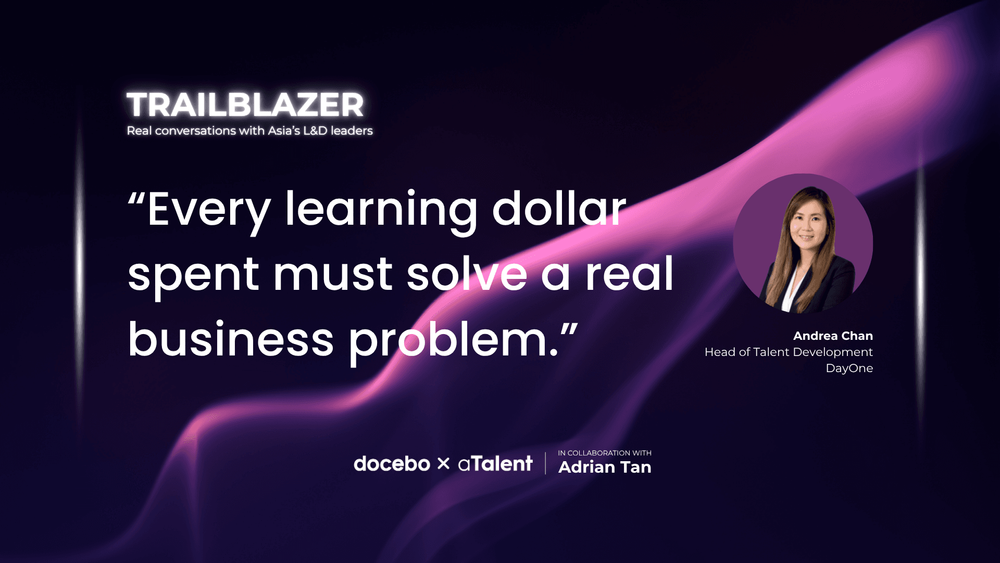
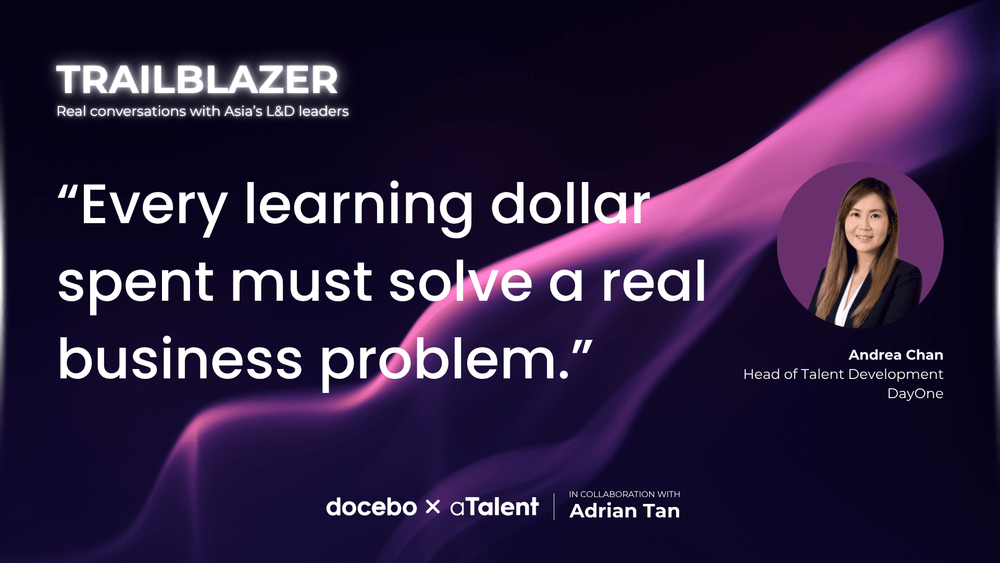
“Every learning dollar that is spent, businesses expect a few times the returns,” she says. “I had taken for granted that people would see the value. In a corporate context, if you’re not making a clear connection between what you’re doing and how it solves a business problem, you remain a cost centre. Everyone thinks they know what L&D should do because they were once a learner. The difference is whether you can connect it to what actually matters to the business.”
That lesson, absorbed early and held close since, shapes everything about how she works today as Head of Talent Development at DayOne, a global data centre operator spanning Singapore, Malaysia, Japan, and APAC.
The High Potential Problem Nobody Named Correctly
Andrea’s clearest example of L&D thinking differently came during one of her previous organisations, where she was pulled into a conversation about attrition. The overall number looked normal. But when the data was broken down by demographics, the picture changed: high potentials were leaving faster than they should.
That was a business problem. It just had not been framed as one.
“If you don’t speak the language of the business, L&D is obsolete,” she says. “By looking through the lens of this as a business problem and how we solve it using the tools we have, the programme we designed landed well.”
The solution was not a training programme. It was a recognition that high potentials have a different relationship with patience than the average employee. They are hungry. They want to grow. If the organisation does not visibly invest in them, they leave because they can. The intervention was about connection and visible commitment, not content delivery.
_“High potentials are not patient. If the organisation doesn’t seem to be investing in them, they have no problem leaving. They’re talented. They don’t need to stay somewhere that doesn’t see that.”_
### Listening Before Prescribing
The widely held belief Andrea pushes back on most consistently is that people already know what L&D should do for their teams. They have sat in training before. They have a hunch about the problem. They arrive with a solution already in mind.
Her job, as she sees it, is not to execute those solutions. It is to ask why they think that solution is the right one, and to listen long enough to find out what the actual objective is before anything is prescribed.
“Everyone tries to tell me they know what their department needs,” she says. “But the most important skill I deploy is the ability to listen and understand what my audience actually needs before suggesting an intervention. I come in with an open mind. I don’t claim to know the business, because I don’t. They are the experts. I let them lead with what they are trying to achieve.”
It is a posture of deliberate restraint that she frames as a partnership. Not a training vendor executing orders. Not an expert arriving with a predetermined solution. A talent partner who earns the right to recommend by first understanding what the problem actually is.

On Earning Stakeholder Trust
Andrea’s approach to senior stakeholders follows directly from that partnership posture. The foundation is demonstrating, early and consistently, that L&D is on the same side as the business, not a cost centre defending its existence, but a function that solves real problems.
The instinct in L&D, she notes, is to lead with the sophisticated model, the elegant framework, the multi-year roadmap. She does the opposite, starting with whatever is most pressing and demonstrating value before asking for anything bigger.
_“I don’t claim to know the business. I let stakeholders lead with what they are trying to achieve, then show them the options. Very complicated learning models won’t fly if you haven’t first delivered on the basics and earned the trust to go further.”_
On AI and What It Frees Up
Andrea’s outlook on AI in L&D is more optimistic than cautious. Her reasoning is practical: if AI handles repetitive and administrative tasks, it releases time for the work that actually requires human judgment, creative thinking, and genuine strategic contribution.
She is also watching a shift in learner behaviour that she thinks L&D has not fully caught up with yet. People increasingly learn just in time, in the moment of need, from whatever source is most immediately useful. The idea of consuming learning as a scheduled activity is giving way to something more fluid and self-directed.
“Just-in-time learning will become even more relevant in an AI world,” she says. “It’s not about having the most learning. It’s about having the most relevant learning at the exact moment of need.”
_“AI frees us from the mundane so our precious time can be spent on strategy and on making the learning experience something people actually look forward to. That’s the real opportunity.”_
The Race She Sees Coming
Andrea’s view of where the profession is falling behind is specific: the gap between data that exists and data that is being used.
Organisations are generating more learning data than ever. But translating that data into meaningful action, into personalised learning pathways, into real-time feedback loops that actually improve how people develop, is happening far too slowly. And as learners become more capable of building their own learning experiences with AI tools, the question of what L&D uniquely offers becomes more urgent.
“If learners can already create their own personalised pathways, how do we value-add to that process?” she asks. “Knowing the most is no longer admirable the way it once was. What matters now is how fast we apply what we know, and how we use the data we have in a meaningful way.”
For Andrea Chan, who moved from a decade in education into corporate L&D and had to rebuild her entire frame of reference, that kind of rude awakening is not something she is waiting to have. She had it early. And she has been moving faster because of it ever since.
Andrea Chan is one of Asia’s featured voices in the aTalent × Docebo Trailblazer Campaign — spotlighting the region’s most influential L&D leaders. Learn more at trailblazer.atalent.com