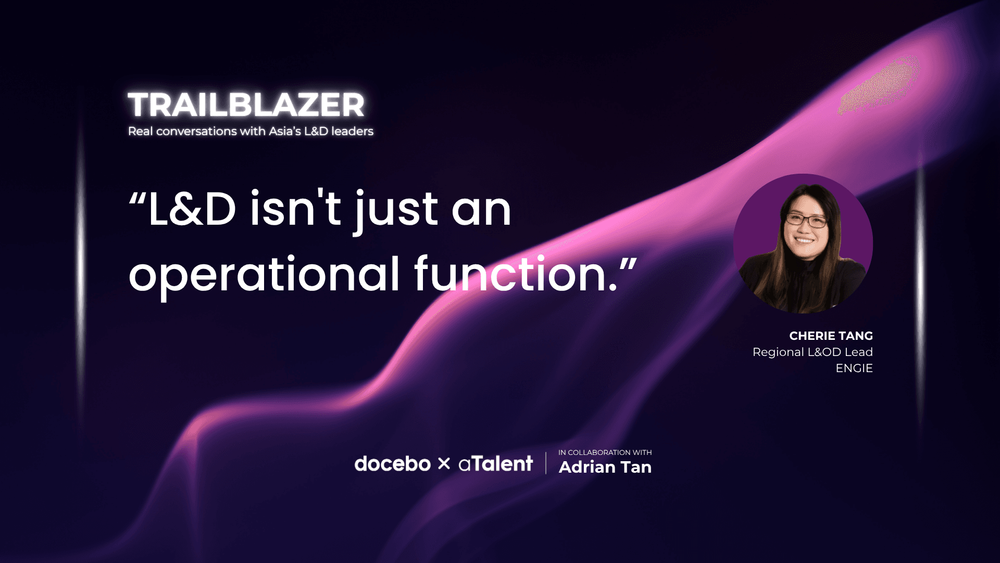
What If the Real Job of L&D Is Teaching People How to Be Kind?
It's not the answer most people expect from a senior L&D leader. But Cherie Tang has never been particularly interested in giving expected answers.
Ask her what she does for a living and she'll tell you, with a laugh, that she teaches people how to be kind. It sounds disarming until she explains it — and then it sounds exactly right. What she's really describing is the persistent work of helping managers understand that the way they treat their people isn't a style preference. It's a choice that shapes everything downstream.
"Sometimes I have to teach — really baby steps — how to treat people, how to grow people, how to instil a growth mindset in managers and leaders," she says. Managers who are unkind are often not malicious, she argues. They're simply replicating what was done to them — operating under the unexamined belief that difficulty and pressure are how people learn. Breaking that cycle, one manager and one team at a time, is at the core of what Cherie does.
On Knowing What You're Not
Cherie's path to that clarity wasn't linear. Early in her career, she took on HR operations and shared services roles — and quickly realised they weren't for her. Not because the work wasn't important, but because it removed the thing she valued most: genuine human connection.
"From a shared services point of view, when you're dealing with data, there's very little connectivity," she says. "You don't see the onsite feedback. You don't understand how your work adds value to the person on the other end."
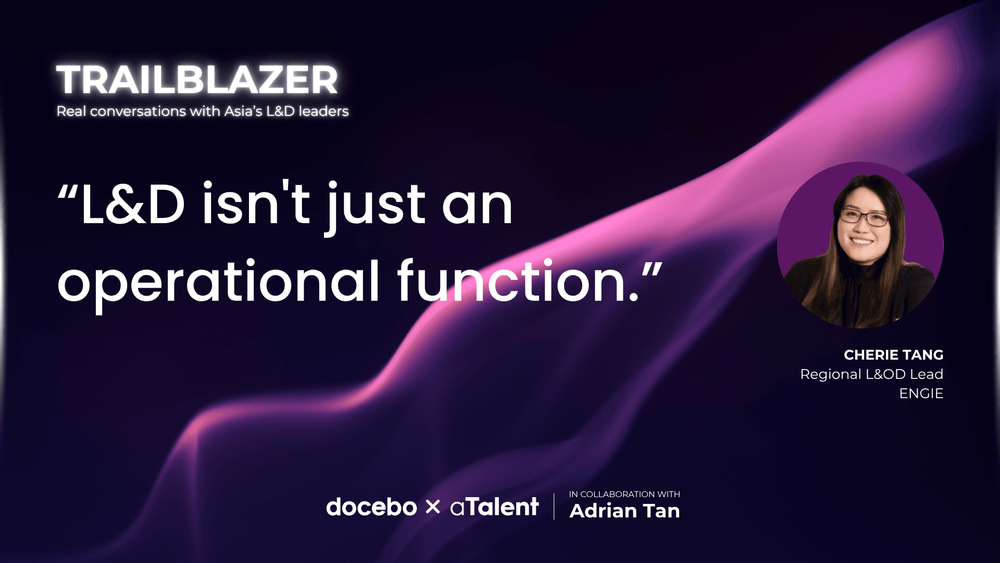
The pivot into instructional design, and later into coaching, confirmed what she already knew. "Coaching really opened up a bigger perspective on what my role could be. L&D isn't just an operational function — it's about where we see the company going, and how L&D helps grow the business into the next phase."
"L&D isn't just an operational function. As we become more strategic, it's really about where the company is going — and how we help it get there."
The Misconception That Costs Companies Their Best People
The belief Cherie pushes back on most forcefully is one she's encountered throughout her career: that L&D is a cost centre, not a value driver — and therefore the first thing to cut when times get hard.
It's a short-term calculation that produces a very predictable long-term result. When companies skip internal development and default to external hiring, good people notice. They read the signal, and they leave. And then those same people go on to flourish somewhere that invests in them.
"You notice that person becomes, in a much better space, because another company invested time, invested money, invested development for this person. Which could have happened where they previously were."
L&D, she argues, is not a training budget line. It's a retention strategy and a growth strategy — the mechanism by which a company builds the capability to move into new markets, take on bigger clients, and compete at a higher level.
"If we don't upskill our people to take on bigger clients and negotiate better, how do we expect the organisation to win against our competitors?"

Making the Case to the Sceptics
When senior stakeholders hesitate over investment in people development, Cherie doesn't lead with ROI tables. She leads with a question.
"I always ask: if we look five or ten years down the road, would you be able to live with the decision you make today?"
The real risk of staying put is invisible in the moment and only becomes obvious in retrospect. "If we don't spend the hundred thousand, we are almost guaranteed that nothing will change," she says. "The worst case of spending it is that people don't learn as much as we hoped. The worst case of not spending it is that we don't grow at all."
On Knowing Where to Start
Cherie's filter for evaluating new technology is straightforward: benchmark first, innovate second. Before introducing any new tool — AI included — she assesses where the organisation actually is, not where it aspires to be.
"If an organisation is still very pen and paper in its day-to-day, it wouldn't be straightforward to just introduce AI," she says. "You have to start where people are."
For organisations already digitally fluent, the conversation shifts quickly. For those still building the foundations, the job is sequencing — getting the basics right before reaching for the ceiling.

"There's no point introducing AI if people aren't yet comfortable with the digital foundations. Build the floor before you build the ceiling."
For Cherie Tang, L&D has always been about the human on the receiving end — the manager who doesn't yet know how to grow their team, the employee whose potential hasn't been seen, the organisation that hasn't understood what its people could do if someone invested in them properly.
It starts, she'll tell you, with teaching people how to be kind. And it turns out that's not a small thing at all.
Cherie Tang is one of Asia’s featured voices in the aTalent × Docebo Trailblazer Campaign — spotlighting the region’s most influential L&D leaders. Learn more at trailblazer.atalent.com