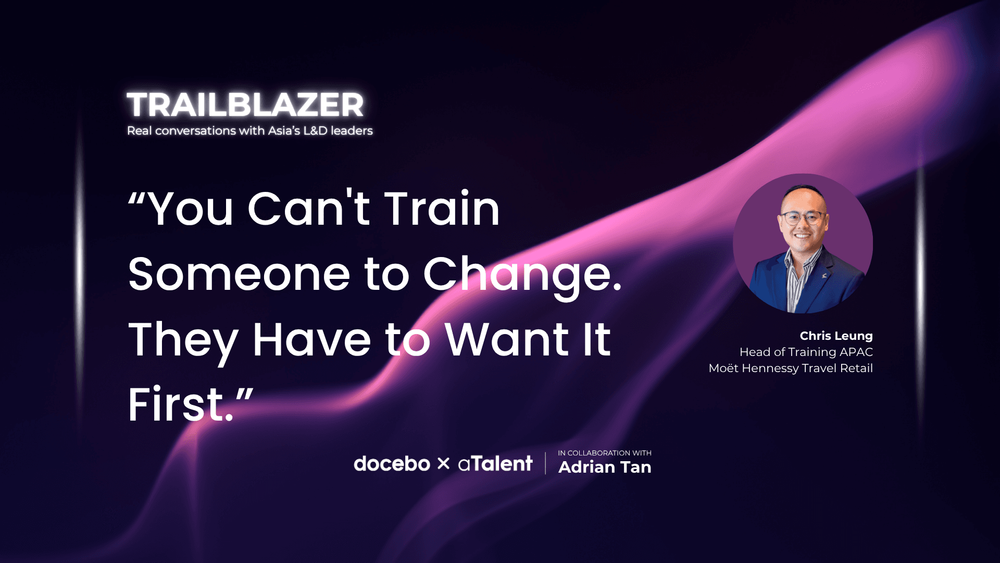
You Can't Train Someone to Change. They Have to Want It First.
Chris Leung has spent his career in some of the world's most prestigious luxury environments — Cartier, A. Lange & Söhne, Bacardi, L'Oréal, and now Moët Hennessy Travel Retail, where he leads Training across APAC. Across all of them, he has noticed the same thing: the hardest part of L&D has nothing to do with content design or delivery. It has to do with readiness.
"Everything comes from within," he says. "You're not expecting someone to change you. You change for yourself. And the question is always: are they ready to make that change? Is it the right timing? Is it the right conditions?"
That conviction sits at the centre of how Chris approaches his work. KPIs matter. Behaviours matter. But underneath both, he is always asking a more fundamental question: what is actually motivating this person, and is that motivation pointing in the right direction?
"Yes, we can look at KPIs and behaviours," he says. "But more importantly, it's the motivations and the drive within you that we're really trying to work with."
Beyond the Sales Number
At Moët Hennessy Travel Retail, where the focus is on a retail sales force operating at the sharp end of luxury brand experience, Chris saw a familiar problem: performance conversations that generated plenty of heat but very little light.
People were being judged. Good or bad, capable or not. But without a shared framework for what good actually looked like, those conversations went nowhere. Everyone was working from a different set of assumptions.
His response was to introduce a more holistic capability assessment built around the ASK framework: Attitude, Skills, and Knowledge. Each element came with a defined set of behaviours. Instead of vague judgments, managers and team members now had a neutral, shared platform from which to have honest conversations about performance and growth.
_"People see things very differently. When you have a neutral shared framework, it's fairer for everyone. And that's what creates the real conditions for capability development." _
The Case for Authentic Leadership
One of Chris's most significant pushes in recent years has been against the idea that effective leaders should all look the same.
Large organisations, he observes, have a tendency to identify the behaviours they want and then try to shape everyone into that single mould. It sounds logical. In practice, it flattens the diversity of personality and motivation that actually makes teams work.
His alternative: authentic leadership development built around understanding who people already are, rather than who the organisation wants them to become. The tool he has championed is the Enneagram, a personality framework that goes beyond surface behaviour to explore the motivations underneath.
"The Enneagram lets you look at how you manage up and how you manage down," he says. "But most importantly, it builds awareness: are you in a healthy state? Can you see your own blind spots?"
"We don't want one type of leader. We want diversity. The Enneagram helps people get the awareness they need to grow into the leaders they actually want to be, not just the leaders someone else designed."

On Getting Stakeholders to the Same Table
Chris's approach to bringing senior stakeholders along on new L&D ideas is grounded in a straightforward principle: everyone has something they are trying to solve. Find the overlap.
"How do we create a win-win for everyone?" he says. "There are things we all want to address. The question is whether the proposed solution genuinely helps each part of the organisation, not just the one making the request."
The work, in his experience, is getting everyone oriented around a common goal before the proposal lands on the table. When senior leaders can see their own priorities reflected in the initiative, the need for a hard sell largely disappears.
On AI and What It Cannot Do
Chris's filter for deciding what to adopt in a fast-moving innovation landscape comes down to a distinction he keeps returning to: substance versus appearance.
AI can make things look polished. It can generate ideas, surface patterns, and accelerate production. What it cannot do, he argues, is feel. And in a profession built on human development, that gap matters enormously.
"Emotions cannot be learnt," he says. "They can only be felt. That's where AI is lacking. And we shouldn't ignore that. We should keep pursuing what makes us human: real emotions, real values. Because those are what AI cannot comprehend."
His view on the future of L&D follows naturally from that: the profession's most urgent task is integrating AI thoughtfully and quickly, not to replace the human dimension of learning, but to free up time and energy for the parts only humans can do.

For Chris Leung, L&D has always been less about what is being taught and more about who is ready to receive it. The content is rarely the variable. The person is. And after fifteen-plus years across some of the most demanding luxury environments in the world, he remains focused on the same question he started with: what does this person actually need to grow into the best version of themselves at work?
The tools and frameworks help. But they are always in service of something more fundamental: the moment when someone decides, for themselves, that they are ready to change.
Chris Leung is one of Asia’s featured voices in the aTalent × Docebo Trailblazer Campaign — spotlighting the region’s most influential L&D leaders. Learn more at trailblazer.atalent.com