The ROI Question Is the Wrong Question. Here’s the Right One.
Connie Cheung has a nickname at CBRE. They call her the bulldozer.
She wears it without apology. With leadership spread across five geographies, waiting for unanimous buy-in before doing anything would mean doing nothing. So she runs her programmes, invites people along, and lets the results make the argument. Most of the time, the people who said no at the start come back asking to join in.
It is a pragmatic stance shaped by fifteen-plus years working across multinational corporations and start-ups in Hong Kong, China, Taiwan, Australia, Indonesia, and Vietnam. And it reflects something Connie believes deeply: that L&D’s job is not to convince people it matters. It is to demonstrate that it does.
Breaking the Mould, Literally
Connie’s description of what she does is unusually direct. “I call it breaking the masks a leader wears and rebuilding them,” she says. Every leader arrives with a mindset shaped by experience, personality, and history. The work of L&D is to surface that mindset, interrogate it, and create the conditions for something different to take its place.
The method she has developed for doing that at CBRE is built around simulation. Four years ago, she moved away from the standard leadership programme format — frameworks on slides, role plays, feedback forms — and introduced technology-enabled simulations where leaders run a company for six quarters, make real decisions, lead virtual teams, and receive feedback from AI characters and their peers in real time.
The results have been sticky in a way that no slide deck ever managed.
“Till today, if I run into one of these alumni in the office, they say: I still remember the character we played three years ago, and it’s impacting how I have difficult conversations with my team,” she says. “Compare that to asking someone what a professor said on a particular slide from a global programme. No one remembers that.”
“Human interaction supported by technology generates new neural pathways. They remember the experience because it had an emotional attachment. That sustains the learning for years. A slide never did that.”
The Middle Manager Nobody Is Looking After
The initiative Connie is most excited about right now is a programme called Elevate, designed specifically for leaders of leaders: the managers sitting between senior executives and frontline teams, some leading two layers of people across geographies they may rarely visit in person.
It is a segment the profession has largely overlooked. Senior leaders have succession programmes. First-time managers have people management workshops. The middle layer gets squeezed from both directions, often leading teams scattered across a region, with very few peers in the same position to talk to.
“It gets lonely in that bucket,” she says. “They build leadership capabilities through growing up the ranks. But leading multiple layers, across locations, with AI and hybrid work changing the dynamics underneath them, that is a completely different capability.”
“After the first workshop, the feedback said it all: ‘I am being pushed from the top, I’ve got layers underneath me requesting everything, I’m stuck in the middle with no room to make mistakes.’ If we can really tackle this group, we can change the organisation.”

The simulation format landed immediately. Participants found peers across APAC facing similar challenges. A community formed around a shared experience. And the recognition that they were not alone, that the loneliness at that level is real and worth addressing, was itself part of what the programme needed to deliver.
The Coaching Conversation That Changed Everything
Connie’s own turning point came from being on the receiving end of a coaching conversation she expected to be unremarkable. As part of piloting EZRA Coaching’s virtual coaching platform before deploying it at her company, she sat down with a coach she had picked from the platform. One hour. No particular agenda.
“Through that one single conversation, something changed in how I see things and how I operate, not just at work but personally,” she says. “I built habits from that hour that have sustained for three years — around how I approach my health, how I manage time, what I prioritise.”
The experience pushed her to get certified as a coach herself, and shifted how she allocates her own time. Less design and delivery. More one-on-one conversations with leaders using the coaching skills she has since built. The personal interactions, coupled with leadership programmes, are more significant than any standalone programme could produce.
On the ROI Question She Hates
Connie is candid about the belief she pushes back on most forcefully: that L&D should be able to demonstrate ROI on a short timeline.
“It’s like asking a teacher after one day of primary school what profession a child is going to be,” she says. “It doesn’t work like that. It takes time for people to practise what they’ve learned, get feedback, have experiences before anything changes.”
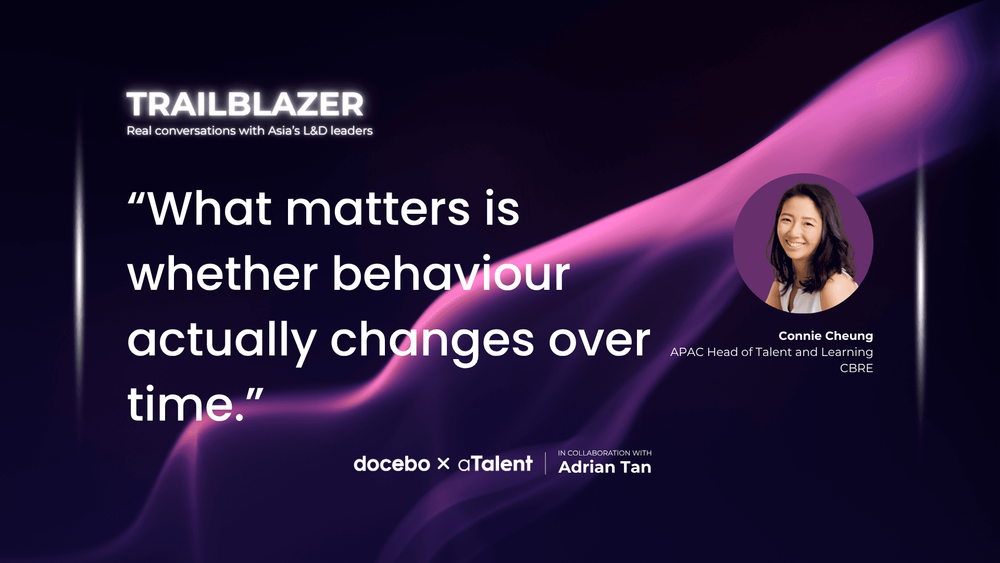
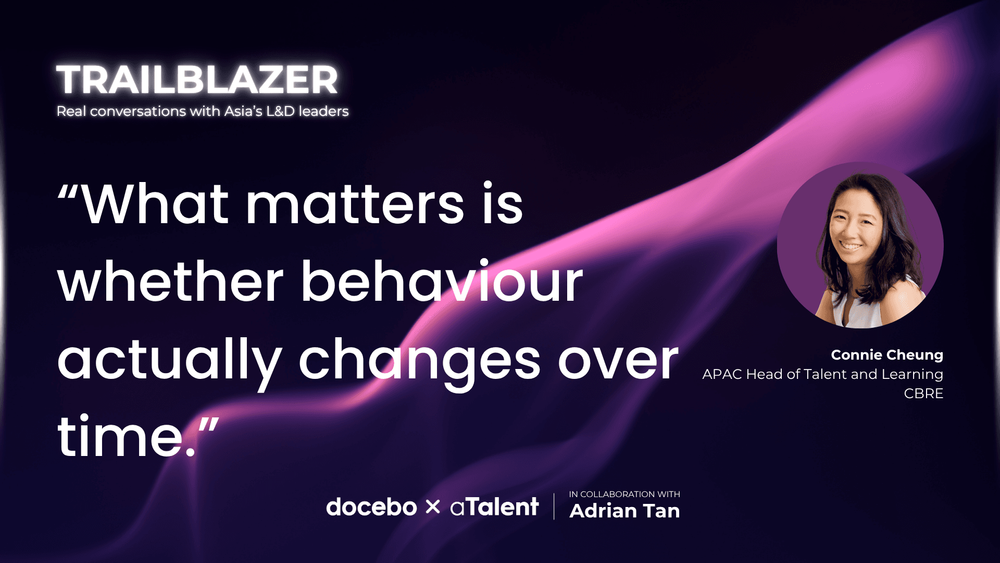
The reliance on satisfaction scores and feedback form numbers, in her view, has not solved the problem. Anyone can make numbers look reasonable. What matters is whether behaviour actually changes over time, and that is not visible on a quarterly dashboard.
What is visible, she argues, is the evidence that accumulates from human relationships built between L&D and the business. Which is also why her answer to the ROI question often starts with getting more deeply into the room where business decisions are made.
“If L&D is building strategies in silo without genuine relationships with business leaders, we will never change fast enough. The seat at the table is not a nice-to-have. It is how we stay relevant when the next wave hits.”

What She Is Cautious About
Connie’s approach to innovation in the profession is selective to the point of being sceptical about some of the loudest trends.
On AI training programmes: cautious. AI is not a skill you learn in a workshop. It is a mindset shift that embeds through use, the same way nobody went to school to learn how to search on Google. Putting someone who has never opened an AI app in their personal life into an enterprise AI training programme is, in her view, a waste of everyone’s time.
On skills frameworks: similarly cautious. The concept is sound, but most companies do not have clean enough data for the frameworks to produce meaningful output. The promise usually outpaces the infrastructure.
What she does believe in: blended learning, with a particular emphasis on in-person for the Asia Pacific. Unlike Western counterparts comfortable with fully virtual instructor-led or self-paced programmes, Asia Pacific learners, in her experience, also need in-person interactions in a physical environment. The camera-off Zoom session is not learning. It is attendance.
For Connie Cheung, the bulldozer metaphor is apt. Not because she overrides people, but because she keeps moving. In a function that is easy to stall waiting for perfect conditions or full consensus, she builds things, shows what they produce, and lets the results decide who follows.
Most of the time, they do.
Connie Cheung is one of Asia’s featured voices in the aTalent × Docebo Trailblazer Campaign — spotlighting the region’s most influential L&D leaders. Learn more at trailblazer.atalent.com