Most OD Practitioners Hand Leaders a Report. Eric Yim Hands Them a System.
The distinction isn't semantic. A report describes what is wrong with an organisation. A system changes the conditions that produced it. That gap — between diagnosis and redesign — is where Eric Yim has spent 25 years working.
Most people who end up in organisational development arrive through psychology. Yim arrived through anthropology. That difference, it turns out, explains almost everything about how he works.
Where a psychologist asks what is happening inside a person, an anthropologist asks what the environment is doing to them. It is a subtle shift in frame — but it changes the entire intervention logic.
“70% of OD practitioners start with the psychology of the individual. I wanted to take the other direction. My hypothesis: if I shape the environment, can I change the behaviour?”
A Non-Traditional Path To A Very Clear Destination
Yim did not set out to work in OD. His academic background was in financial analysis. His first career move was in corporate banking. What eventually pulled him sideways was a subject he stumbled into at university: organisational behaviour. He loved it immediately, and it quietly reoriented everything that followed.
His entry into OD came through knowledge management in the public sector — a discipline that nobody at the time would have connected to OD, but which gave him something most practitioners lack: a systems lens. Organisations as organisms.
Information as a flow to be traced, not a database to be filled. Tacit knowledge as the thing that actually runs most of what happens inside any workplace.
From there, each role he chose added another facet. Diversity and inclusion. Learning and development. Organisation effectiveness. Strategy execution. Each one, in his mind, was part of the same larger picture.
"My mind was very clear," he says. "It’s all different facets of OD. But of course, if you talk to different people, they may see them as very different disciplines."
The Belief Worth Pushing Back On
Yim’s sharpest disagreement with conventional OD thinking is not a rejection of leadership development. It is a correction of its scope.
Leadership is important. He believes that genuinely. But the widespread assumption that leadership is the centre of everything — the single lever that determines organisational outcomes — misses something fundamental about how change actually works.
Context shapes leaders too. The environment around them determines which behaviours are possible, which ones get reinforced, and which ones quietly die.
Blaming leaders for not walking the talk, without examining the conditions that make the talk difficult, is in his view a diagnosis that stops too early.
"Sometimes it’s up to us to mobilise leadership in a certain way," he says. "Put them in a context where they understand certain things. It’s not just that they have to understand. It’s also on us to help them."
He points to the Hawthorne effect as a practical illustration: when leaders are put in the spotlight, behaviour shifts. Create the right conditions, and even peer pressure will do the work that no amount of training could.
Where OD Shows Its Real Value
The work Yim is proudest of sits at the intersection of organisation design and strategy execution. End-to-end org design — the kind that examines structure, process, capability, culture, and the patterns across all of them together — is, in his view, the fullest expression of what OD can actually do.

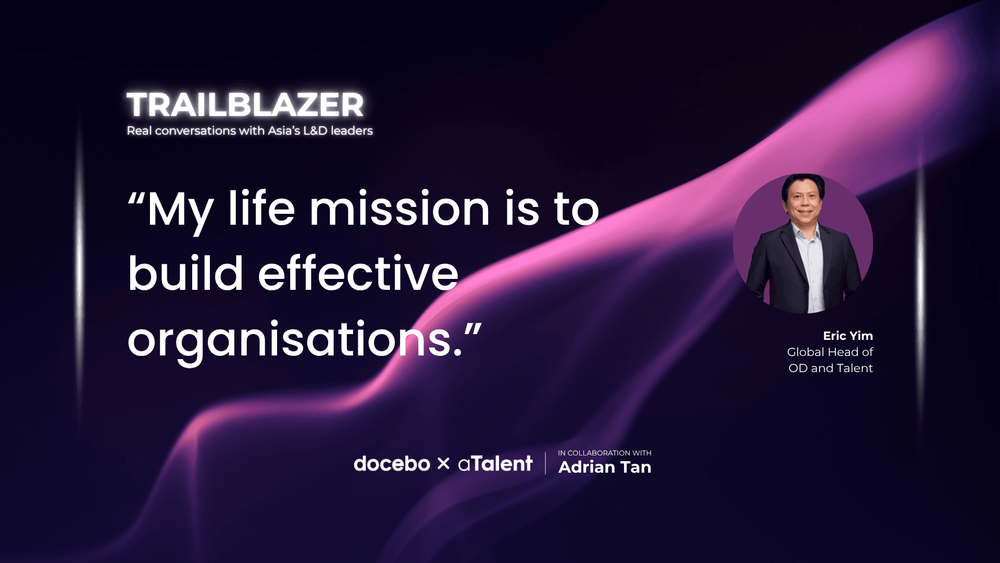
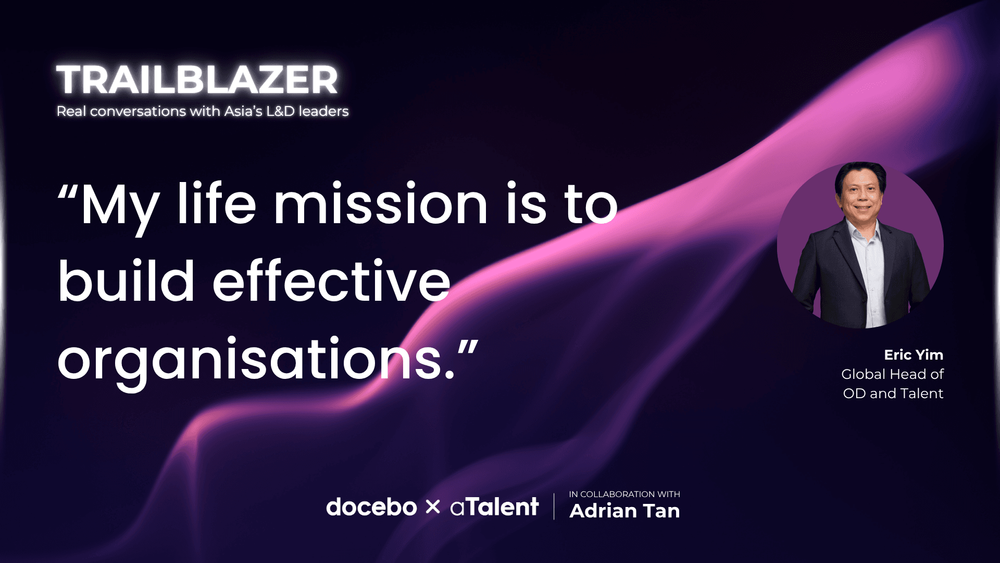
“My life mission is to build effective organisations. The best representation of OD is when you do end-to-end org design work with a business leader — looking at structure, process, people, capability, and culture together — and then design and deploy an organisation that is genuinely fit for purpose.”
At the enterprise level, his focus has shifted toward talent. Specifically, the ability to build a multidimensional picture of how individuals are developing over time — drawing from engagement surveys, talent assessments, performance data, and recognition patterns — and synthesising it into something that gives senior leaders a cleaner, less opinion-driven view of the people they are betting on.
"I act as a mirror," he says. "But also as a data point. So decisions are driven by data and evidence, not just by opinions."
The Practitioner Who Builds
What separates Yim from most voices in the AI-and-HR conversation is that he does not theorise about what AI could do for organisations. He builds working tools — and tests them against real organisational behaviour.
The diagnostic instruments he has developed independently sit at the intersection of OD methodology and AI capability: not off-the-shelf software, but instruments designed around how organisational problems actually present themselves. Capability gaps. Structural misalignments. Talent risks that surface in the data before they surface in the boardroom conversation.
The hypothesis only becomes useful when you can instrument it. Describing an environment is anthropology. Changing it requires knowing exactly which levers move which behaviours — and building the feedback loops that tell you whether they are working.
That combination — deep OD domain knowledge, AI capability, and the ability to build tools that operationalise both — is rare. Most practitioners have the domain knowledge. A smaller number understand AI. Very few can turn that understanding into a working prototype that a leadership team can actually use.
“Before asking what AI is good for, I ask: does this help me better understand the work itself? That’s the North Star. Everything else maps onto that.”

On AI And The Question Nobody Is Asking Properly
Yim’s approach to the AI conversation is characteristic: he starts further back than most. Before asking what AI is good for, he wants to understand the work itself more precisely.
Every role is a collection of tasks. Some of those tasks only a human can do. Some are best supplemented by AI. Some could be fully autonomous. The problem he sees is that most organisations are trying to answer that question by feeding job descriptions into an AI tool and accepting whatever it produces.
"That’s not precise enough," he says. "Not clear enough."
His filter is a simpler question: does this help me better understand the work that is required? Effective and fulfilling work is his North Star. Any tool that gets him closer to that understanding is worth exploring. Any tool that does not — regardless of how much noise surrounds it — is not.
The Reckoning Ahead
The criticism Yim sees coming for OD is pointed. The function exists, in one of its core definitions, to help organisations navigate and sustain change. That is its purpose. And the most consequential change of the current era is the integration of AI into how work is actually done.
If OD does not help organisations adapt to the AI age faster — if it does not build the bridge between the people function and the technology function — then it will have failed at the precise moment it was most needed.
"Why isn’t OD helping organisations adapt to the AI age much faster?" he asks. "Why doesn’t OD help integrate the HR people function and the technology function? We should be able to see it coming. But are we doing anything about it?"
The OD function was designed to anticipate and navigate change. The irony, as Yim sees it, is that it has been slow to apply that capability to its own transformation. His response is not to wait for the function to catch up. It is to demonstrate what is possible — one working prototype at a time.
Eric Yim is one of Asia’s featured voices in the aTalent × Docebo Trailblazer Campaign — spotlighting the region’s most influential L&D leaders. Learn more at trailblazer.atalent.com