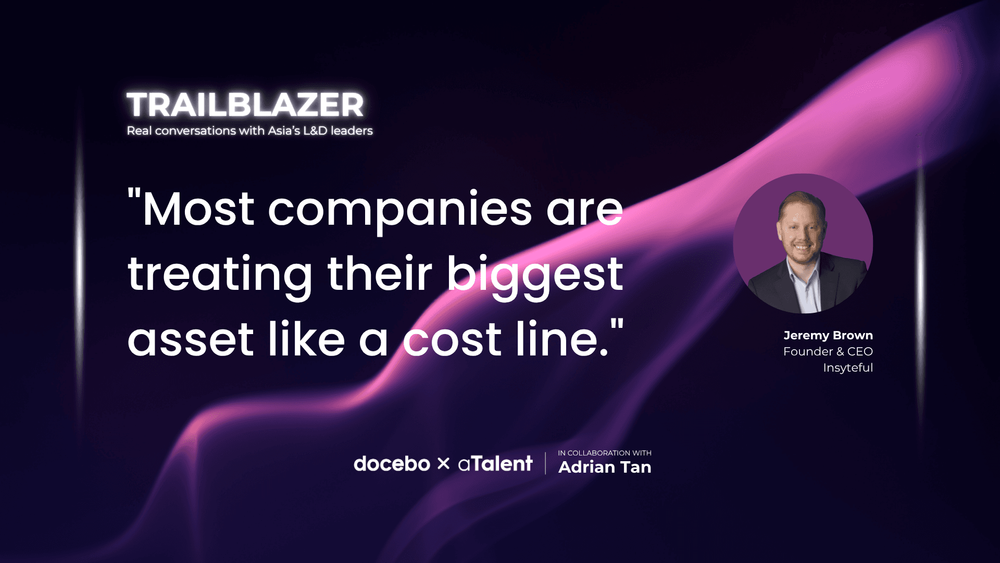
Most Companies Are Treating Their Biggest Asset Like a Cost Line.
Jeremy Brown will tell you upfront: he is not an L&D person. He has never designed a curriculum, never run a workshop, never thought much about learning science. What he has done is sit on the other side of the table for twenty years, making business decisions, and watching company after company under-invest in the one asset that determines whether their strategy actually worked.
Their people.
“A lot of companies are seeing learning and development through the prism of a cost rather than an investment,” he says. “And I think the risk for founders, now more than ever, is one of under-investing in their people and the skill base in the organisation.”
That perspective, built across twelve years at American Express, more recently as as COO at regional FinTech, Atlantic Partners Asia, where he scaled its operations, growing the team and scaling operations trading volume from USD 500M to USD 2.5B, and now as founder of Insyteful, an AI-powered learning platform for APAC SMEs, is what makes Jeremy’s voice in this space unusual. He did not come to L&D through the science of how people learn. He came through the commercial reality of what happens when they don’t.
The Asset That Gets Ignored
The scenario Jeremy keeps returning to is one most founders recognise but rarely quantify. You have 250 people. Real capital is going out the door every month to fund their roles and entitlements. And the assumption, often unspoken, is that if someone underperforms, you go back to the market and find a replacement.
It sounds pragmatic. The numbers tell a different story.
In my experience, a top performer leaving takes six to nine months to replace. During that time, the organisation burns energy, momentum, and institutional knowledge. The replacement arrives at a higher cost than its predecessor. And the underlying problem, that the person was not equipped to grow in the role, has not been addressed at all.
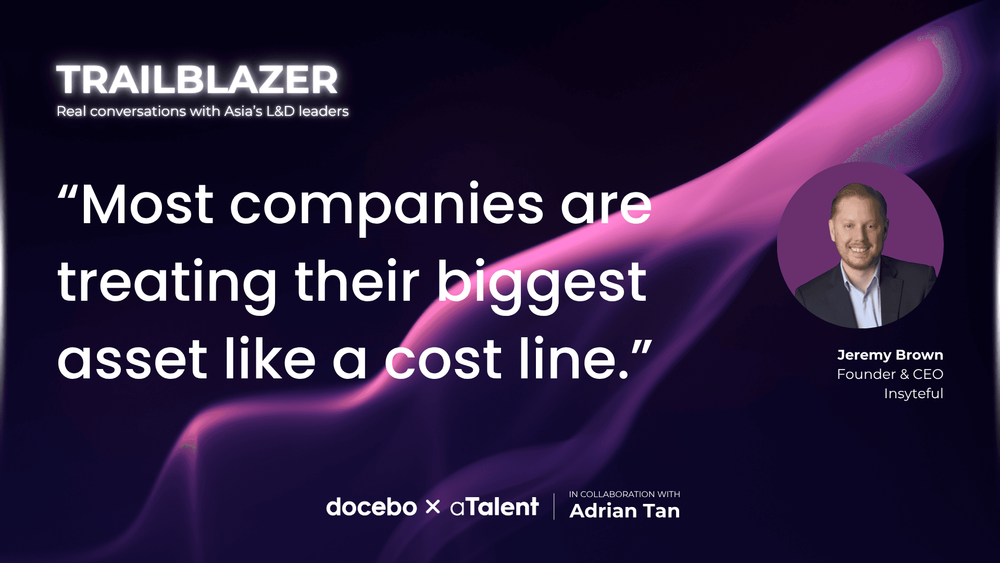
“High performers need the capability and tools to stretch. Underperformers need the right tools to improve. Either way, the cost of losing them dwarfs what it would have cost to develop them," Jeremy says. "Either way, losing them costs far more than developing them ever would.”
Training, in his framing, is not a nice-to-have. It is risk management.
“Under-investing in your people has regulatory impacts, audit impacts, and potential brand damage impacts. The risk of not training is just as real as the risk of bad training. Most founders haven’t done that math.”
The Gap He Decided to Build For
When Jeremy looked at what was available for mid-market businesses trying to build a proper learning function, he found a gap that frustrated him as an operator and eventually pushed him to build a solution himself.
Companies of 200 to 500 people are too big for simple off-the-shelf tools that cannot handle the complexity of real workforce development. They are too small for enterprise-grade platforms that require a dedicated team to manage and incur costs accordingly. The result is a patchwork. Multiple training vendors. No unified view. No clear line from learning activity to business outcome.
Insyteful, which is being built in partnership with docebo as the LMS backbone and aTalent for skills intelligence, is his answer to that gap. The platform maps role requirements against competency frameworks, surfaces individual skill gaps, connects learners to relevant content from a curated library, and produces ROI reporting that a CFO can actually read.
“The promise is live in one week, simplified admin in two weeks, and a first CFO-ready ROI report in 90 days,” he says. “Because if you can’t show ROI, the investment won’t be renewed.”
“Mid-market companies are too big for simple tools and too small for enterprise platforms. That gap is where Insyteful sits: skills intelligence, curated content, and ROI reporting in one place, built specifically for APAC SMEs.”

On AI and What It Cannot Replace
Jeremy’s view on AI in L&D is shaped less by enthusiasm for the technology than by a clear-eyed read of what it can and cannot do.
Content creation: AI can do it, and increasingly well. But accreditation still matters. A CPD-certified course carries something that AI-generated content does not: evidence that it has been reviewed, validated, and judged suitable. That signal will not disappear.
Enterprise infrastructure: the LMS-is-dead argument does not hold up. Cybersecurity, data privacy frameworks, integration capability, and long-term development roadmaps are not things a vibe-coded platform provides. Enterprise platforms like docebo will remain because the things that make them valuable are not replicable quickly.
In-person training: not replaceable. Full stop.
“People need people,” he says. “The bounce effect in a room, where one person’s question triggers something in someone else, that is where something happens that online learning cannot reproduce. The human layer in learning is incredibly important. And I think it will be more important in the future, not less.”

“People need people. The human layer in learning is incredibly important. And I think it will be more important in the future, not less.”
What the Market Is Moving Toward
Jeremy’s prediction for where L&D is heading in five years is grounded in something he has already started to see: a shift from general content to deep vertical learning.
MBA graduates from prestigious institutions are taking longer to find jobs. The market is moving toward business-specific qualifications. Even at the top, the picture has shifted: the share of Harvard MBAs without a job offer three months out nearly quadrupled between 2021 and 2024 — from 4% to 15% (Bloomberg, 2025). I see a shift moving toward business-specific qualifications, role-specific training, and learning that can be applied immediately to a defined problem. General content libraries will struggle to compete with that. The providers who survive will be the ones who go deep into specific verticals and make their content directly actionable.
“There has to be a switch toward deep vertical learning that is transactional and applicable,” he says. “How do I solve this specific problem? Not generalist content hoping something sticks.”
For Jeremy Brown, it all comes back to the same equation he has been running his whole career: what did we invest, and what did we get back? L&D has not always been good at answering that question. He is building a platform that makes not answering it much harder.
Jeremy Brown is one of Asia’s featured voices in the aTalent × Docebo Trailblazer Campaign — spotlighting the region’s most influential L&D leaders. Learn more at trailblazer.atalent.com