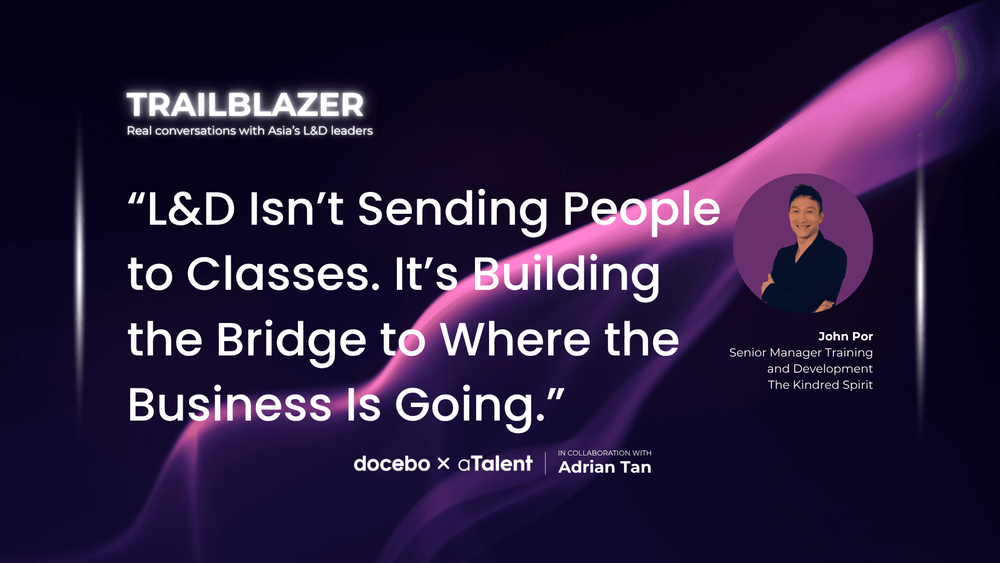
L&D Isn’t Sending People to Classes. It’s Building the Bridge to Where the Business Is Going.
Ask John Por what he does, and you will not hear the word training for very long.
“My job is about future-proofing the business and the people in it,” he says. “It’s not about sending people to classes. It’s about looking at where the business is going, say opening new clubs or launching a Personal Training department, and asking: do we have the right people with the right skills to make that a success? If not, I'll build the bridge to get them there.”
That framing is not incidental. Throughout a career spanning The Kindred Spirit, True Group, and Attitude Performing Arts, John has consistently approached L&D less as a training function and more as an internal consulting practice, one that uses coaching, skill-building, and programme design to ensure the people in an organisation can actually deliver on its strategy.
At Anytime Fitness, the franchise brand he now leads, L&D strategy under The Kindred Spirit, which meant not designing a course for staff when the company needed to grow membership. It meant building entire Personal Training and Group Exercise departments from scratch, creating new product offerings that changed the member experience directly and measurably.
Pivoting Aggressively When Everyone Else Paused
When COVID hit the fitness industry, the conventional move was obvious: pause in-person training, wait for things to return to normal. John did the opposite.
At True Group, he introduced and built an online content series for members during lockdowns. It was a direct deviation from the standard playbook, and it served a dual purpose: it preserved membership revenue, and crucially, it created new jobs for full-time instructors at a moment when the wider industry was collapsing around them. “It wasn’t just a training programme,” he says. “It was a business survival and talent retention strategy.”
His team was also the first to recover live training, meeting all critical operational objectives while competitors were still waiting things out.
“It wasn’t just a training programme. It was a business survival and talent retention strategy. That’s proof L&D can be the engine of business continuity, not just a support function.”

The Belief He Pushes Back On
John’s sharpest disagreement with conventional L&D thinking is the assumption that training fixes performance problems. Sales are down, so send the team to a sales workshop. He has seen this reflex play out repeatedly, and his experience tells him it rarely solves anything systemic.
At True Group, facing operational gaps, he could have mandated more training. Instead, he led a change management initiative to redesign the reporting structure and workforce management methods. The problem was not a lack of skill. It was a lack of clear workflow and accountability.
“L&D must be the architect of the environment that allows performance to happen,” he says. “We design the systems, the career pathways, the coaching culture.”
“At The Kindred Spirit, I transformed a data entry staff member with an accuracy issue not by putting them in a data entry course, but by coaching for understanding, accountability, and initiative. I addressed the person and the process, not just the skill.”
Turning a Data Vacuum Into a Revenue Story
The pivotal moment that shaped John’s current approach came at True Group, when he realised the Group Exercise department was operating with no way to measure its own impact. Classes were bundled into gym membership, so there was no tangible link between attendance and business performance. Decisions were being made on intuition, not evidence.
He worked with IT to extract the data he needed: participation, attendance, and retention trends. Then he identified high-potential trainers and developed them into Program Heads, each responsible for a specific class programme, training them not just in instructional excellence but in data literacy, reporting, and business acumen. The result was a new hierarchy where instructors became business partners within their own domains, equipped to track metrics, audit performance, and present insights upward.
“With this new hierarchy in place, I presented a clear, data-backed business case to the C-suite,” he says. “Group Exercise wasn’t just a value-add or a cost centre. It was a revenue driver, with measurable impact on retention and renewals.”
Building a Self-Sustaining Ecosystem, Not a One-Off Workshop
The initiative John points to as his clearest reflection of building real organisational capability is the enterprise-wide L&D framework he built from the ground up at True Group: over 36 accredited courses, a 99% certification rate across his department, and clear career progression paths for instructors.
What made it work, in his view, was its holistic design. It was tied directly to the company’s expansion strategy. It offered employees a genuine roadmap to grow. And it required managing a network of 27 studios and partnerships with Les Mills and Zumba to ensure relevance across every outlet.
“This initiative cemented my belief that building organisational capability means creating a self-sustaining culture of growth,” he says. “Not just delivering training.”

Selling Risk Reduction, Not Novelty
When John introduces unfamiliar ideas to senior stakeholders, he deliberately avoids framing them as new HR initiatives. He frames them as risk mitigation with measurable business impact.
Introducing the Matrix Business Management model at True Group, a genuinely new and complex way of working, he did not pitch it as an HR concept. He presented the operational gap, the cost of that gap, and exactly how the model would reduce it. He also uses small pilots deliberately, letting early positive data do the persuading — at The Kindred Spirit, a new PT department generating ten thousand dollars in revenue made the case on its own.
“I speak their language: revenue, retention, and efficiency,” he says. “I show them how the unfamiliar idea reduces their risk and increases their profit.”
“I don’t pitch the novelty of the idea. I pitch the cost of the status quo and how this reduces it. Once the data shows a positive trend, buy-in becomes much easier.”
The Filter for Every New Trend
John’s test for any new tool or trend is consistent: does this solve a real business problem, or help achieve a specific strategic goal? If there is no clear line of sight to improving the workforce’s ability to execute the business strategy, he moves on.
Even his own certifications reflect this discipline. He pursued ACTA because he needed a rigorous framework to achieve a 99% certification rate, not to collect a credential. He pursued NLP training because he needed advanced conflict management and stakeholder engagement skills to mediate workplace harassment cases and complex business negotiations.
“I focus on innovations that give me the tools to be a more effective business problem solver,” he says. “Not just the latest tech gadget.”
What the Profession Will Be Criticised For
John’s view of where L&D is falling short is direct: the profession is moving too slowly to become a purely strategic business driver, remaining too focused on content delivery rather than problem-solving. Many L&D functions are too slow to adapt to the speed of business change, too attached to rigid structures like fixed curricula, when what is needed is hyper-agile, on-demand solutions.
His own career, building departments from ground zero, pivoting through a pandemic, restructuring organisations without the luxury of a year-long analysis, reflects his attempt to move at the speed the moment actually demands.
“The future of L&D is in strategic consulting and business partnership,” he says. “Those who don’t embrace this mindset will be seen as a sunk cost rather than an organic investment.”
John Por is one of Asia’s featured voices in the aTalent × Docebo Trailblazer Campaign — spotlighting the region’s most influential L&D leaders. Learn more at trailblazer.atalent.com