The Hardest Discipline in L&D Isn't Knowing What to Adopt. It's Knowing What to Say No To.
TingFeng Tan did not arrive in L&D through the usual door. Before designing learning programmes, he was an energy analyst, a valuation controller at Barclays Capital, a business development professional in electronics, and then a Business lecturer at Nanyang Polytechnic for nearly eight years, teaching entrepreneurship, design thinking, and business innovation to students and working professionals alike.
That unusual path, commercial, analytical, and deeply practical, shapes everything about how he approaches the profession today. As Director of Learning & Development at a leading electronics retailer, he is not interested in L&D as a service function. He is interested in it as a capability engine.
"L&D isn't about clocking hours for the sake of it," he says. "It's about helping people stay relevant and actually perform better at work. We should be enablers of capability, not course organizers."
Stepping Back to Scale Up
One of TingFeng's most deliberate departures from conventional L&D practice came when he stopped positioning himself as the trainer and started turning team leads into trainers for their own people.
The logic was straightforward. Team leads already know their people, their day-to-day challenges, and the context in which learning has to land. A centralised L&D team designing programmes in isolation will always be one step removed from that reality.
"Instead of running the training myself, I coached the team leads on how to develop their teams effectively," he says. "That makes learning scalable and relevant, which is critical, especially across different geographical locations."
The Moment That Shifted Everything
TingFeng's clearest pivot came not from a strategic insight, but from a room full of workshop participants. Some were enthusiastic, others sceptical, and many simply treated the session as a break from their desks.
That gap forced him to confront a truth that now underpins everything he does: making a workshop engaging is not enough. Energy in the room is not the same as learning.
"I realised it's not enough to make workshops fun and have everyone laugh," he says. "I need to build rapport and show participants that what they're learning has real value for their work."
The insight was simple but fundamental: learning only works when people see the relevance and want to apply it, not because HR or their manager sent them.
_"Learning only works when people see the relevance and want to apply it. Not because HR or their manager sent them. That mindset guides everything I do."_

Design Thinking as a Live Problem-Solving Tool
The initiative TingFeng points to with most pride is a design thinking programme, valued not because of how it was designed, but because of what participants did with it afterwards.
One example stays with him. A participant in an administrative role attended carrying a familiar frustration: her team's daily work was bogged down by manual processes, prone to error and slow. After working through the design thinking framework, covering empathy mapping, problem definition, and ideation, she went back and implemented a semi-automated solution that meaningfully reduced both time and error rate.
"She didn't see it as theory," TingFeng says. "She built something tangible she could keep working on after the workshop."
That is his test for any learning intervention: not whether people remembered it in the room, but whether they did something different because of it afterwards.
Reframing the Conversation With the C-Suite
When TingFeng needs to bring senior leadership along on an unfamiliar idea, he doesn't frame it as a training request. He frames it as a strategic question.
Working with an organisation under competitive pressure, the insight was clear. Staff were capable but lacked a common framework for problem-solving beyond their existing processes. They weren't equipped to challenge the status quo, which was both a skills gap and a strategic risk.
"The question we put to the C-suite was: if your competitors are outpacing you on innovation, and your people don't have the mindset or tools to respond, that gap will only widen. What are you willing to do about it?"
"We reframed the conversation from a training request to a strategic decision," he says. "Stop reporting on learning activity. Start reporting on business exposure."
The design thinking programme that followed was built around practical tools people could apply to real problems, not concepts to be learned and forgotten.
On Saying No to the Shiny Tool
TingFeng is blunt about the pressure L&D teams face to be seen doing something with AI. He has sat through the vendor pitches, with impressive tools, sophisticated agents, and the latest models. And he has said no to most of them.
His filter is a single question: does this change what someone can actually do on a daily basis? If he cannot answer that clearly, he moves on.
"Chasing trends is often an anxiety response," he says. "L&D teams can feel invisible, so we reach for the shiny tool to justify our seat at the table. But I'd rather justify my seat through the business outcomes I can help enhance."
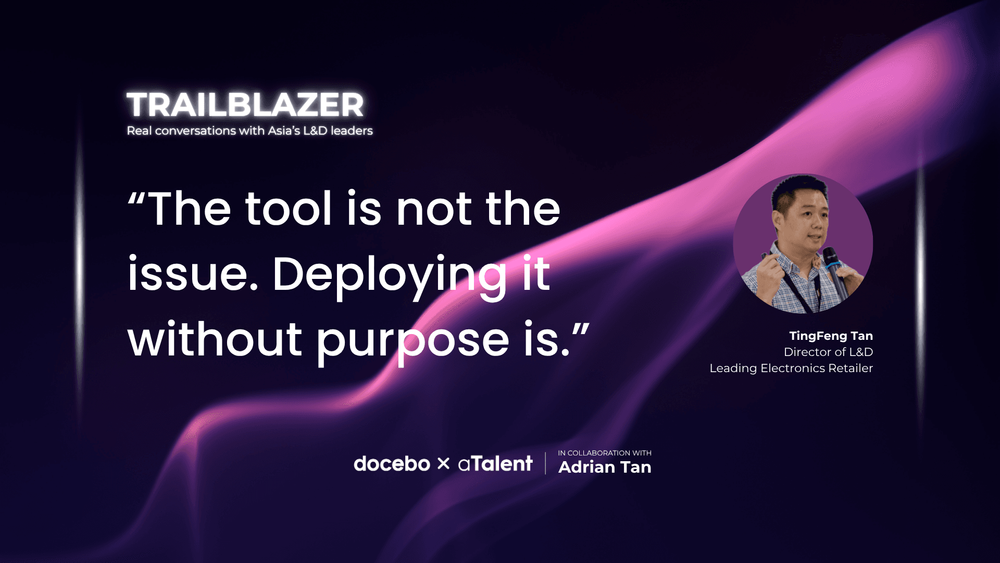
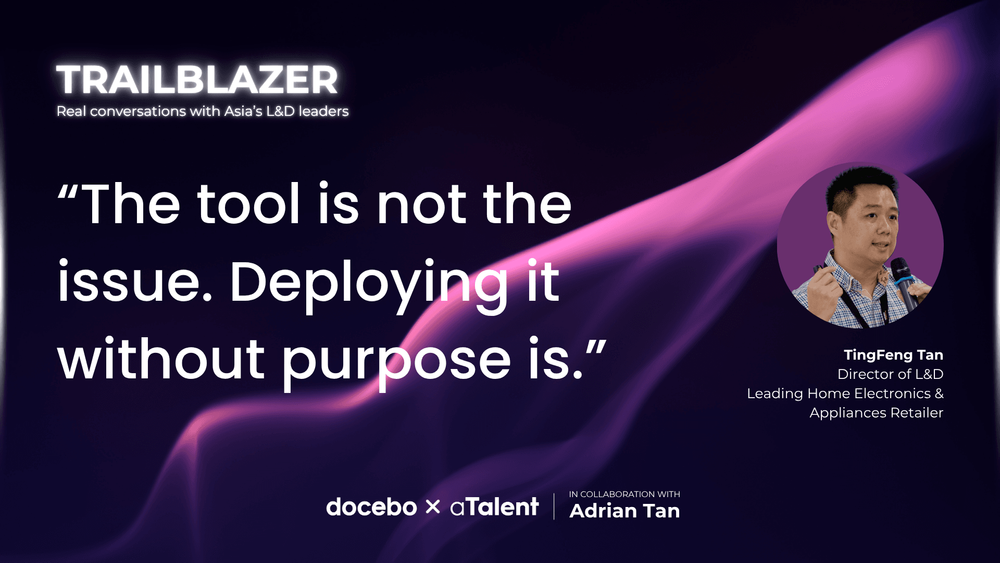
Where AI genuinely solves a capability problem, such as personalised practice, quality feedback, or reducing time to competence, he is fully in favour. The tool is not the issue. Deploying it without purpose is.

"Chasing trends is often an anxiety response. I'd rather justify my seat at the table through business outcomes, not by being seen to adopt the latest tool."
The criticism coming for the profession, TingFeng believes, won't simply be about moving too slowly on technology. It will be about misreading what technology is actually for. The most important work in L&D, which is reading a room, sitting with discomfort, and asking the questions nobody else will ask, is precisely what AI cannot replicate.
"The L&D leaders who thrive in the next five to ten years won't be the ones who adopted the most tools," he says. "They'll be the ones who got clear on what they're actually here for, which is mindset change at the individual level and culture change at the organisational level."
For TingFeng Tan, that clarity has been hard-won. And it shows.
TingFeng Tan is one of Asia's featured voices in the aTalent × Docebo Trailblazer Campaign — spotlighting the region's most influential L&D leaders. Learn more at trailblazer.atalent.com